You can make a terrible decision and get lucky. You can make a smart decision and still lose.
The quality of a decision and the quality of its outcome are two different things.
Most people judge their decisions based solely on results. When things go well, they assume their process was sound. When things go poorly, they assume they made a mistake. This creates a misleading feedback loop that keeps them from learning what actually matters.
The problem is simple: outcomes are probabilistic, not deterministic.
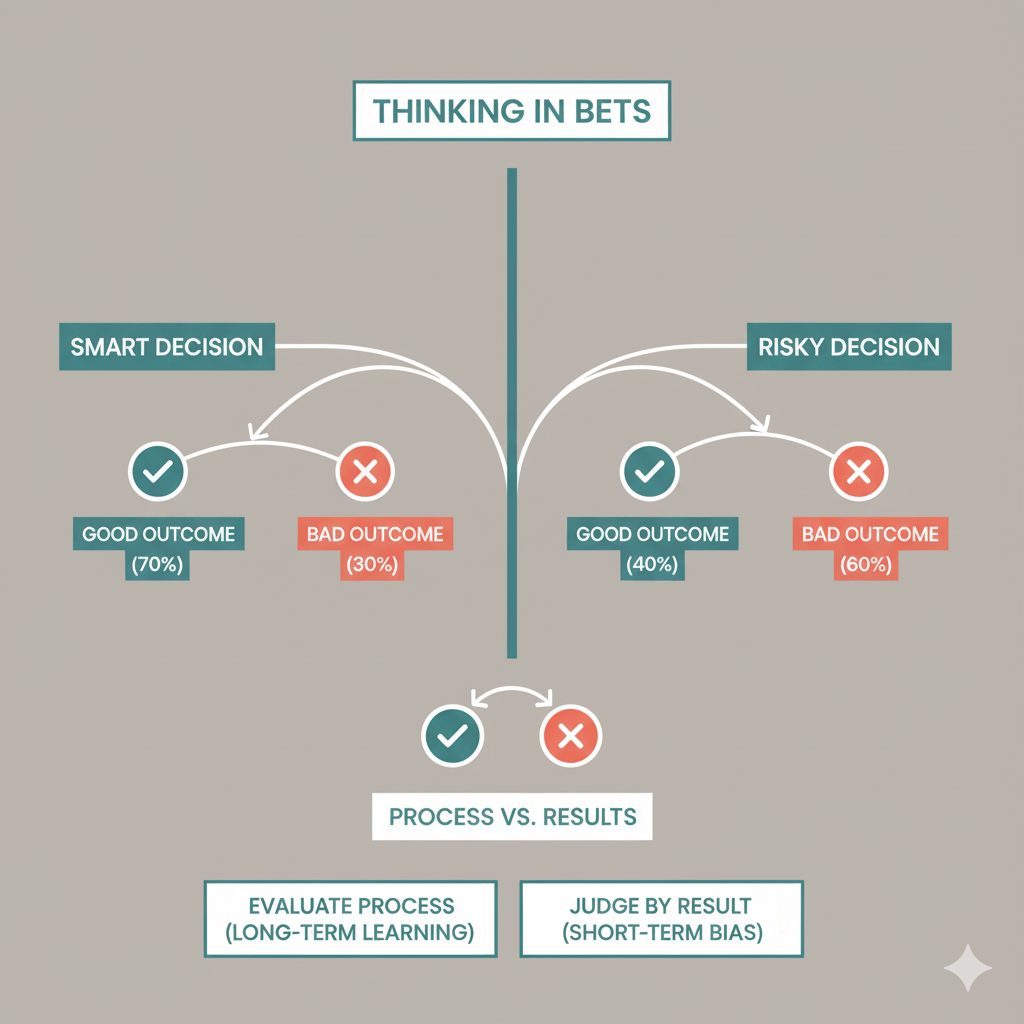
The Difference Between Process and Results
Imagine you’re deciding whether to drive home after having two drinks. You feel fine, and it’s only a ten-minute drive. You make it home safely.
Was that a good decision?
Most people would say no, even though the outcome was fine. Why? Because you understand that the decision created unnecessary risk. The outcome doesn’t change the quality of the choice.
Now flip it around.
You decide to invest in a diversified index fund for retirement. Twenty years later, you would have been better off buying a single tech stock that skyrocketed. Does that mean your diversification strategy was wrong?
Again, no. The decision was sound based on what you knew and the probabilities involved. You just didn’t get the lucky outcome.
This is thinking in bets. It’s about evaluating decisions based on the information available at the time and the likelihood of different outcomes, not just what actually happened.
Why We Struggle with Probabilistic Thinking
Our brains aren’t naturally wired for probability. We want certainty. We want clear cause and effect.
This leads to two common mistakes.
Resulting: Judging a decision based solely on its outcome. If it worked out, it must have been a good decision. If it didn’t, it must have been bad.
Hindsight bias: After something happens, we convince ourselves it was predictable all along. We retrofit our understanding to match the outcome.
Both of these patterns keep us from learning what actually matters—the quality of our decision-making process.
How to Think in Bets
Thinking probabilistically doesn’t mean you need to calculate exact percentages for every choice. It means shifting how you frame decisions.
1. Replace Certainty with Likelihood
Instead of asking “Will this work?” ask “How likely is this to work?”
Instead of “Is this the right choice?” ask “What’s the probability this leads to a good outcome?”
This small shift acknowledges uncertainty and helps you weigh options more realistically.
2. Consider Multiple Possible Outcomes
Good decisions account for different scenarios, not just the one you hope will happen.
Before making a choice, map out a few possibilities:
- Best case scenario
- Most likely scenario
- Worst case scenario
Then ask: Given these possibilities and their likelihood, is this decision worth making?
3. Separate Decision Quality from Outcome Quality
After something happens, resist the urge to judge your decision by its result alone.
Ask yourself:
- Based on what I knew at the time, was this a reasonable choice?
- Did I consider the right factors?
- Was my thinking process sound?
Sometimes you make a great decision and get unlucky. Sometimes you make a poor decision and get lucky. The goal is to build a process that puts probability on your side over time.
4. Think in Expected Value
Expected value is a simple way to compare options when outcomes are uncertain.
You don’t need complex math. Just think about it like this:
If you had to make this decision 100 times, what would be the average outcome?
This helps you see past individual results and focus on what works over the long run.
Applying Probabilistic Thinking to Real Decisions
Career Choices
Should you take a new job offer?
Instead of agonizing over whether it’s “the right move,” think about probabilities:
- How likely is it that this role helps you build valuable skills?
- What’s the probability you’ll enjoy the work?
- If it doesn’t work out, how easily can you course-correct?
You’re not looking for certainty. You’re looking for favorable odds.
Financial Decisions
Should you buy that house? Invest in that opportunity? Start that business?
Map out scenarios:
- If the market shifts, can you handle the downside?
- What’s the range of possible outcomes?
- Are you betting an amount you can afford to lose?
Thinking probabilistically doesn’t eliminate risk. It helps you take smart risks while avoiding reckless ones.
Relationships and Personal Life
Should you move to a new city? End a relationship? Make a major lifestyle change?
These decisions feel too personal for probability, but the framework still helps:
- What are the different ways this could play out?
- What information am I basing this on?
- If I had to give advice to a friend in this situation, what would I say?
The goal isn’t to remove emotion. It’s to balance intuition with clear thinking.
The Long-Term Advantage
Thinking in bets won’t guarantee perfect outcomes. Nothing will.
But it changes how you learn from experience. Instead of being swayed by luck—good or bad—you build a more accurate understanding of what actually works.
Over time, this compounds.
People who think probabilistically make better decisions on average. They don’t get every choice right, but they get more of them right. They learn faster because they evaluate process, not just results.
Most importantly, they’re less likely to fool themselves. They know that a good outcome doesn’t validate a reckless choice, and a bad outcome doesn’t necessarily mean they were wrong.
Start Small
You don’t need to overhaul your entire decision-making process overnight.
Start by noticing when you judge decisions purely by results. Catch yourself when you think “That worked, so it must have been smart” or “That failed, so it must have been wrong.”
Then pause and ask: Based on what I knew then, was this decision sound?
That simple question shifts your thinking from certainty to probability. From hindsight to foresight. From luck to process.
You might not control outcomes, but you can control the quality of your choices. That’s where your leverage is.
And over time, better choices lead to better results—not every time, but more often than not.
That’s the bet worth making.
Leave a Reply