I recently completed a comprehensive 7-week course on overcoming worry and generalised anxiety using Cognitive Behavioural Therapy (CBT) techniques. This course has transformed how I understand and manage my worries, and I wanted to share what I learnt here for anyone else struggling with excessive worry (and future myself).
Table of Contents
📚 Understanding CBT: The Foundation
CBT is an active, practical treatment that focuses on the “here and now.” It’s not something done to you—it’s about becoming your own expert in managing your mood.
What CBT Is and Isn’t
| ✅ CBT IS | ❌ CBT IS NOT |
|---|---|
| Evidence-based and effective | Something done to you passively |
| Problem-solving focused | Just “thinking positive” |
| Practical skills you can use | About complaining about problems |
| Requires active participation | A quick fix without effort |
| Practice outside sessions | Effective without doing the work |
Key principle: CBT only works if you do the work. It requires commitment, practice, and willingness to try new approaches.
🧠 What Is Worry and Why Do We Do It?
Worry and anxiety are normal human responses to perceived threats. A small amount can even be helpful—motivating us to prepare for exams or protecting us from danger.
When Does Worry Become a Problem?
Normal anxiety becomes generalised anxiety when it is:
✗ Excessive
✗ Feels uncontrollable
✗ Intrusive and persistent
✗ Causes significant distress
✗ Impairs daily functioning
🚨 The Danger Brain: Our Evolutionary Alarm System
Our bodies evolved with a “fight or flight” response to keep us safe from life-threatening dangers.
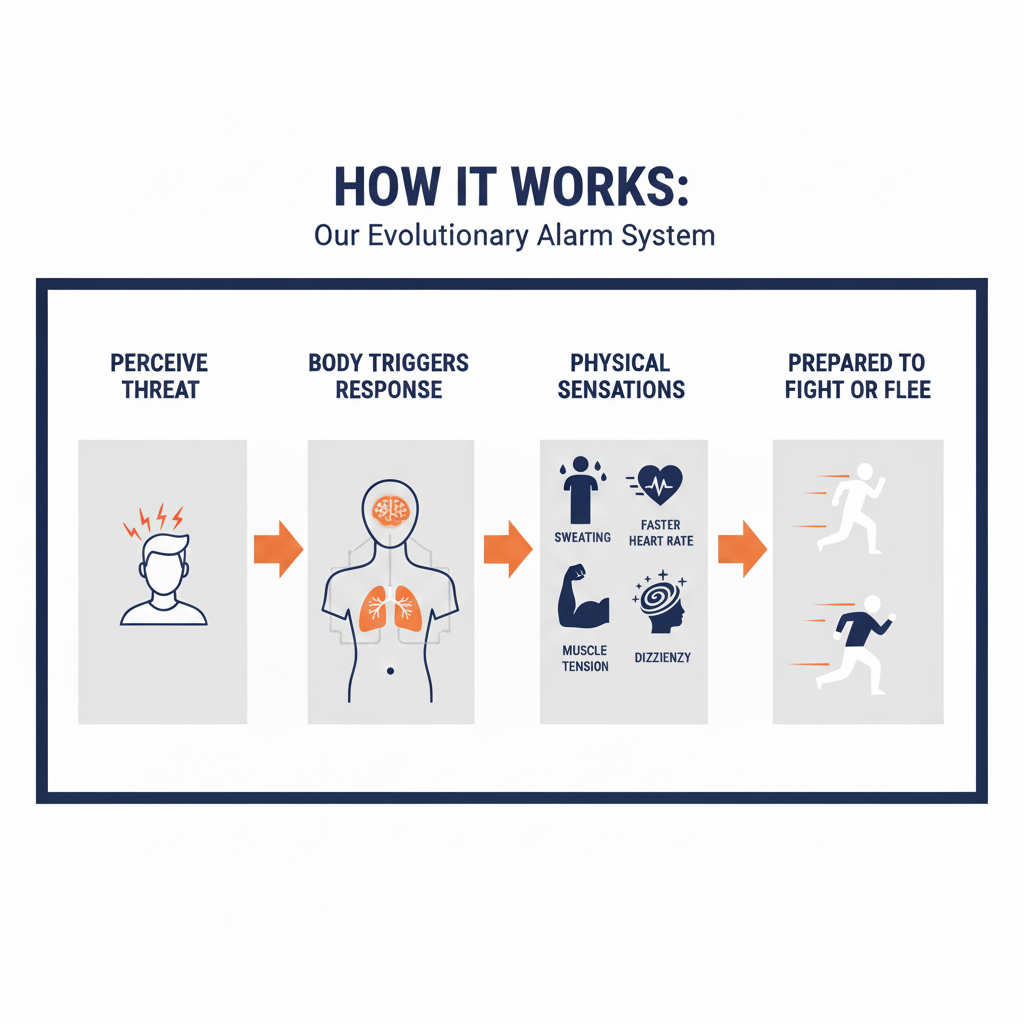
The modern problem: This oversensitive alarm system gets triggered by daily stressors rather than actual life-or-death situations. Since we can’t physically fight or run away from most modern stressors, we worry as a way to cope.
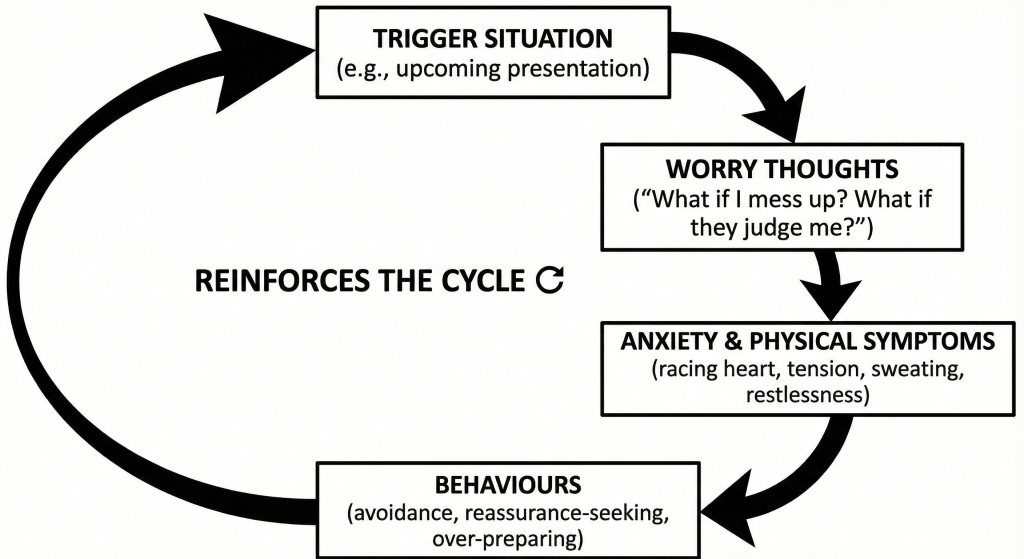
🔄 The Worry Cycle: Understanding What Keeps Us Stuck
💭 Beliefs About Worry That Keep Us Stuck
| POSITIVE Beliefs (Why we keep worrying) | NEGATIVE Beliefs (Why worrying feels bad) |
|---|---|
| “Worrying helps me cope with things” | “Worrying is dangerous and will harm me” |
| “If I keep worrying, bad things won’t happen” | “I can’t control my worrying” |
| “Worrying helps me solve problems” | “It will never stop” |
| “Worrying motivates me to act” | “I’ll have a breakdown if I keep worrying” |
| “Worrying prepares me for anything” | “My worrying will take over completely” |
Critical insight: If we believe worry serves a purpose or prevents bad outcomes, we’ll continue doing it. Challenging these beliefs is essential to breaking free.
🔍 Two Types of Worries: A Critical Distinction
Understanding this difference is fundamental to managing worry effectively:
| 🌫️ HYPOTHETICAL WORRIES | 🔧 PRACTICAL PROBLEMS |
|---|---|
| About things that might happen in the future | About current situations we can address |
| Not within our current control | Have possible solutions |
| Often start with “What if…?” | Can be tackled with problem-solving |
| Can spiral endlessly | Have concrete action steps |
| Examples: | Examples: |
| • “What if I get ill?” | • “I don’t have enough money to pay my phone bill” |
| • “What if my partner dies in an accident?” | • “I have two deadlines due next Friday” |
| • “What if I fail?” | • “My car needs repairing” |
🌳 The Worry Tree: Your Decision-Making Tool
When a worry enters your mind, use this simple flowchart:
                    ┌─────────────────────┐
                    │   WORRY APPEARS     │
                    └──────────┬──────────┘
                               ↓
                    ┌─────────────────────┐
                    │ Can I do something  │
                    │  about this NOW?    │
                    └──────────┬──────────┘
                               ↓
                    ┌──────────┴──────────┐
                    ↓                     ↓
            ┌──────────────┐      ┌──────────────┐
            │      NO      │      │     YES      │
            │ (Hypothetical│      │  (Practical  │
            │    worry)    │      │   problem)   │
            └──────┬───────┘      └──────┬───────┘
                   ↓                     ↓
        ┌──────────────────┐   ┌──────────────────┐
        │ DISENGAGE from   │   │ USE PROBLEM      │
        │ the worry using: │   │ SOLVING:         │
        │ • Worry time     │   │ • Define it      │
        │ • Refocusing     │   │ • Brainstorm     │
        │ • Visualization  │   │ • Choose action  │
        │ • Let it pass    │   │ • Plan & do it   │
        └──────────────────┘   └──────────────────┘
🛠️ Disengagement Strategies for Hypothetical Worries
Since hypothetical worries are about uncertain futures we can’t control, we need to learn to disengage:
1️⃣ Worry Time
- What: Set aside 15-30 minutes daily at the same time/place for dedicated worrying
- How: When worries pop up during the day, postpone them to your worry time
- Why: Teaches you that you can control when you worry
2️⃣ Worry Notepad
- What: Write down worries when they arise, then set them aside
- How: Keep a notebook handy, jot down the worry, close the book
- Why: Externalizes the worry and gives permission to let it go temporarily
3️⃣ Attention Control Training
Exercise: When you notice yourself worrying, redirect attention to:
| Sense | What to Notice |
|---|---|
| 👁️ Sight | Colours, shades, shapes, shadows, lines, edges |
| 👂 Sound | Distant sounds, close sounds, how you’d describe them |
| 🤚 Touch | Textures, temperatures, surfaces |
| 👃 Smell | Any scents in your environment |
| 👅 Taste | What you can taste right now |
Result: Focusing on the present naturally reduces anxiety levels.
4️⃣ Creative Techniques
| Technique | How It Works | Why It Helps |
|---|---|---|
| Singing It | Sing your worry to a funny tune (Go Compare advert) | Breaks the negative meaning |
| Repetition | Say the key word over and over (“weather, weather, weather…”) | Makes worry lose meaning |
| Funny Voice | Imagine Kermit the Frog saying your worry | Reduces emotional impact |
| Visualization | Picture yourself calm and confident in the situation | Creates positive mental rehearsal |
5️⃣ The Train Metaphor
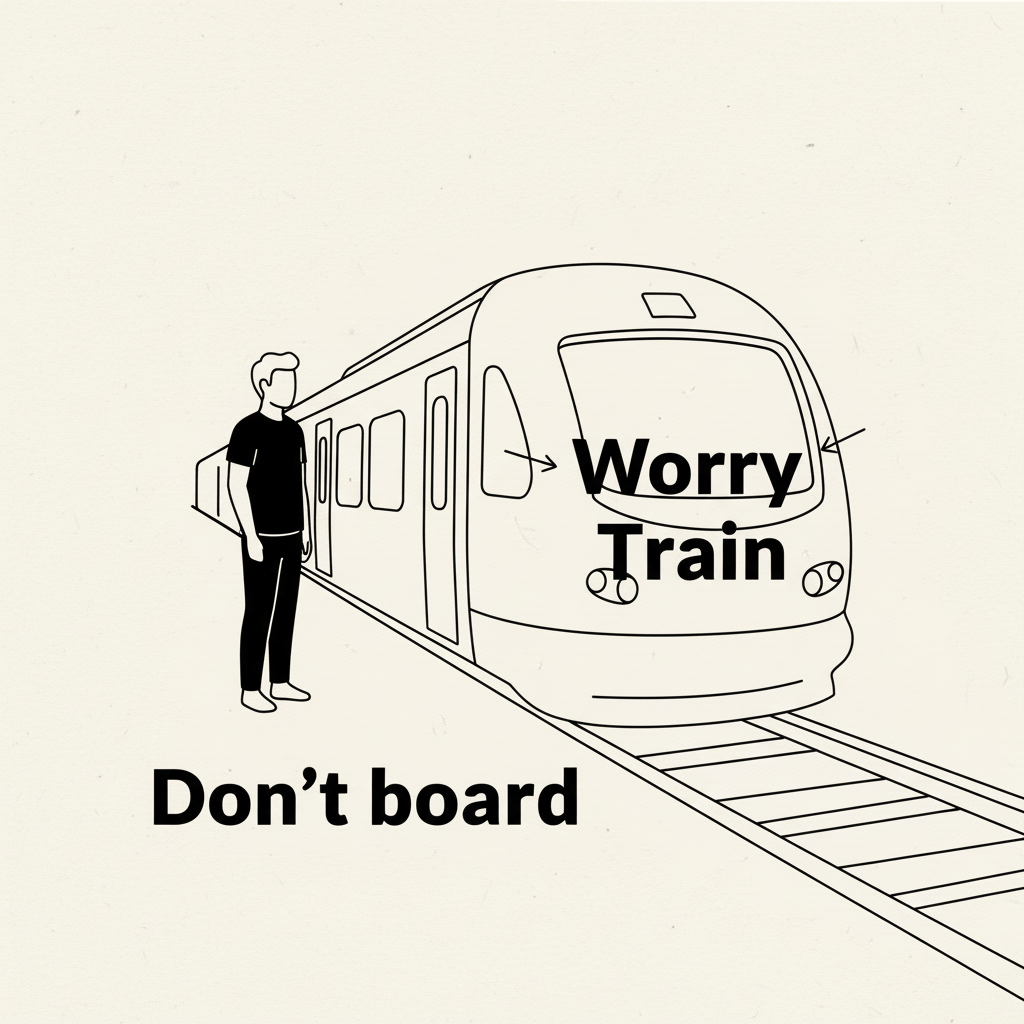
(Observing thoughts without engaging)
Key: You don’t need to board every train of thought. Let unhelpful worries pass by.
🔤 The 4 U’s of Hypothetical Worry
Categorize your hypothetical worries to help let them go:
| Category | Question to Ask | Example |
|---|---|---|
| Unimportant | Does this truly matter in the bigger picture? | Worrying about a minor social faux pas from last week |
| Unlikely | What’s the actual probability? | “What if a meteor hits my house?” |
| Uncertain | Can this be predicted or known? | “What if the weather is bad next month?” |
| Uncontrollable | Is this within my sphere of influence? | “What if there’s a recession?” |
🎲 Tolerating Uncertainty: The Core Challenge
People who worry excessively struggle with uncertainty. We try to eliminate it through various behaviours:
Common Certainty-Seeking Behaviours
| Behaviour | Example | Why It’s Problematic |
|---|---|---|
| 🚫 Avoidance/Procrastination | Not opening post to avoid bad news | Eliminates uncertainty temporarily but increases anxiety |
| 🤝 Excessive Reassurance-Seeking | Repeatedly asking “Are you sure?” | Never truly reassures, creates dependence |
| 📝 Making Lists | Multiple detailed to-do lists daily | Time-consuming, prevents action |
| ✔️✔️ Double Checking | Checking locked door 5+ times | Erodes confidence in own judgment |
| 👎 Refusing to Delegate | “Only I can do it right” | Exhausting, prevents growth |
| 📚 Over-Preparing | Preparing for every possible scenario | Wastes time and energy |
| 😶 Avoiding Conflict | Never disagreeing with anyone | Suppresses authentic self |
| 🏃 Never Relaxing | Staying constantly busy | Uses distraction to avoid feelings |
| 💭 Worrying | “If I worry, I’m preparing” | Creates illusion of control |
The problem: These behaviours keep us engaged with uncertainty, maintain anxiety, don’t solve anything, and erode our confidence.
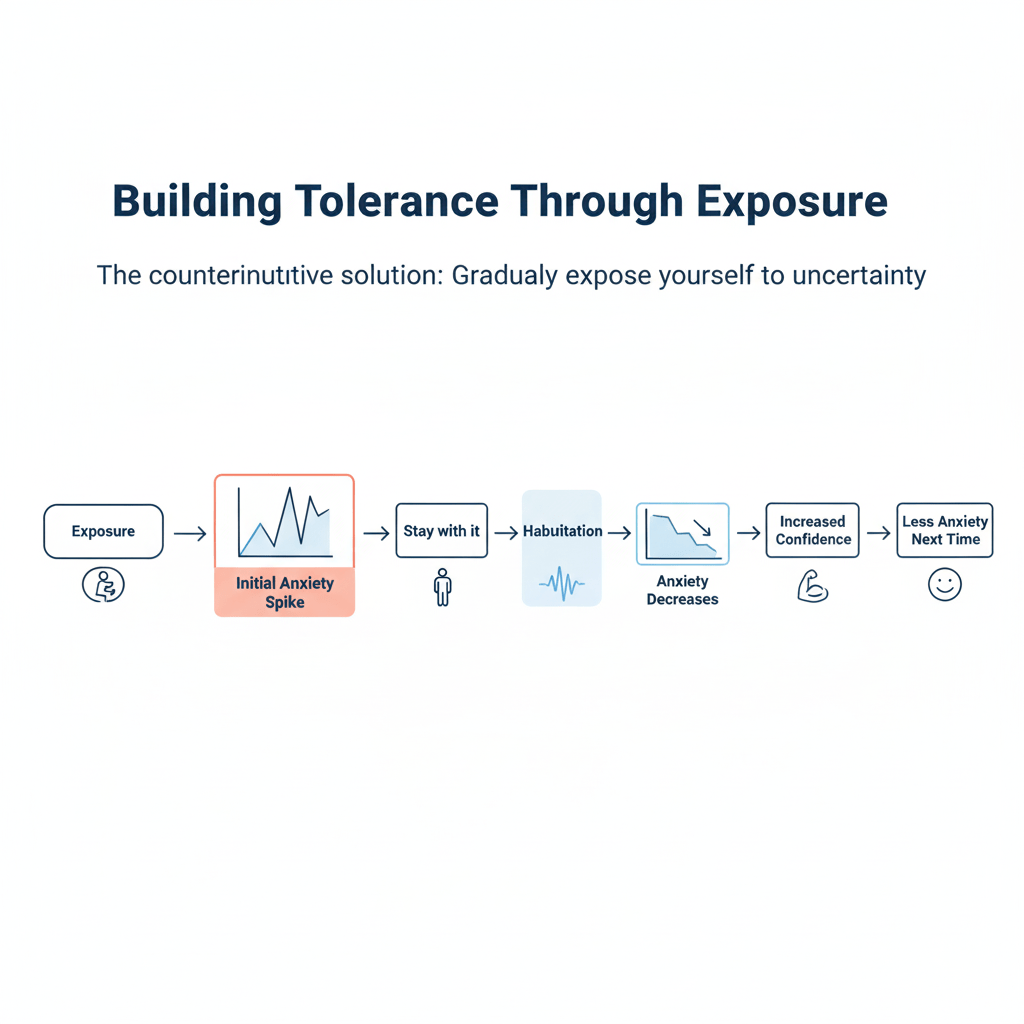
📈 Building Tolerance Through Exposure
The counterintuitive solution: Gradually expose yourself to uncertainty
How it works:
Exposure → Initial Anxiety Spike → Stay with it → Habituation →
Anxiety Decreases → Increased Confidence → Less Anxiety Next Time
🎯 Practical Exposure Goals
| Unhelpful Behaviour | Example Goal |
|---|---|
| Avoidance/procrastination | “I will go to the supermarket I’ve been avoiding and shop for 20 mins” |
| Reassurance seeking | “I will send one email without getting someone to check it first” |
| List making | “I will only make one to-do list per day” |
| Double checking | “I will check I’ve locked the door one fewer time each day” |
| Refusing to delegate | “I will ask John to do the filing and I won’t check his work” |
| Over-preparing | “I will only prepare for the most likely scenario” |
| Avoiding conflict | “If I disagree with someone this week, I will tell them” |
| Never relaxing | “I will spend 20 minutes in the bath with no distractions” |
Remember: Start small and build up gradually. Anxiety will peak, then naturally decrease.
🧘 Understanding Automatic Thoughts
The White Rabbit Experiment
Try this: Don’t think about a white rabbit for 30 seconds.
Result: Nearly impossible, right? If a meaningless image is hard to suppress, imagine how much harder it is to push away thoughts that have emotional significance.
Key insight: Don’t try to suppress worrying thoughts (it backfires). Instead, find balance—use disengagement strategies while allowing thoughts to exist without fighting them.
Negative Automatic Thoughts (NATs) vs Worries
| 🗣️ Negative Automatic Thoughts | 🌪️ Worries |
|---|---|
| Negative self-statements | Future-focused “what if” scenarios |
| “I’m not good enough” | “What if I lose my job?” |
| “I’m a failure” | “What if someone gets ill?” |
| “People don’t like me” | “What if something bad happens?” |
| “I’m worthless” | “What if I can’t cope?” |
Important: Both types of thoughts don’t have any more truth than neutral automatic thoughts—they just feel more significant because of their emotional charge.
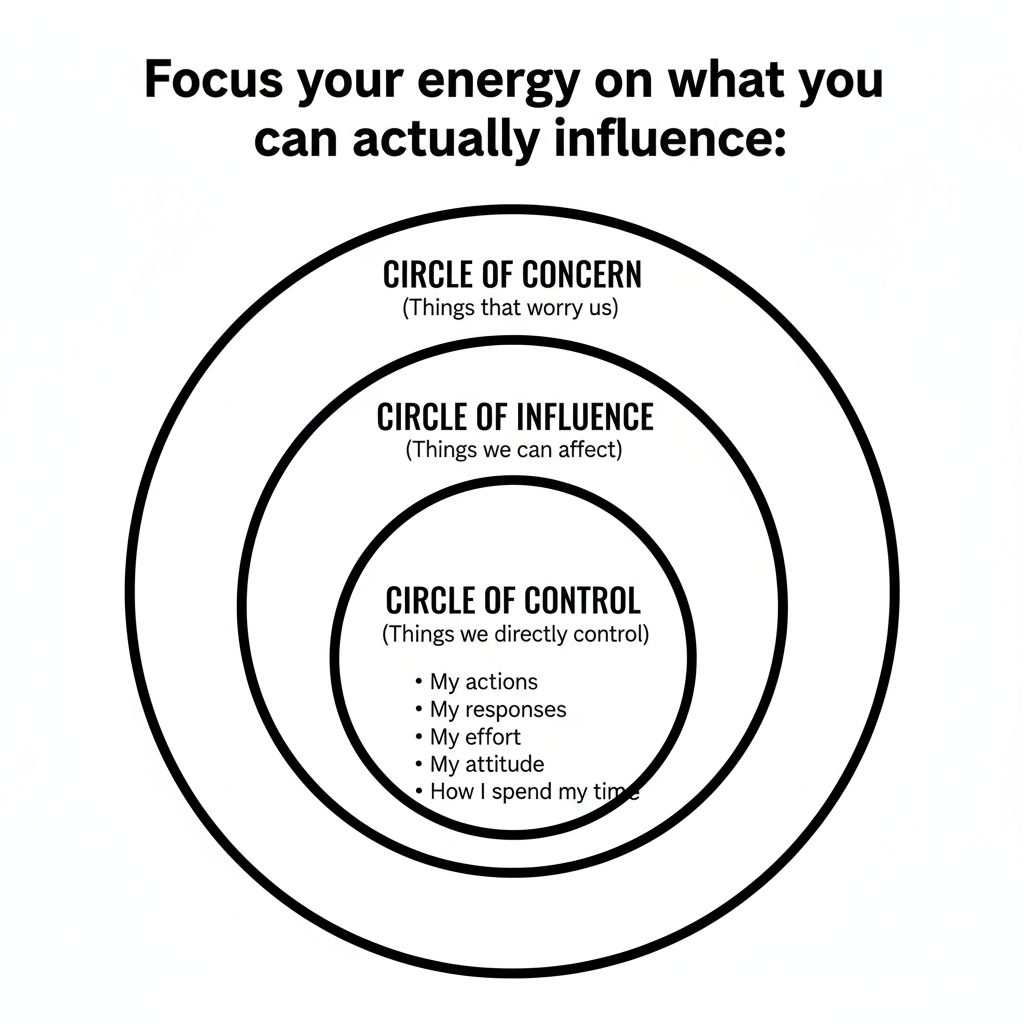
⭕ The Circle of Control
Focus your energy on what you can actually influence:
Proactive vs Reactive Thinking
| 💪 Proactive (Within Your Control) | 😰 Reactive (Outside Your Control) |
|---|---|
| “I can deal with unexpected things” | “If only I had more time” |
| “I can be more organised” | “If only other people did things properly” |
| “I can be more understanding” | “I’d be happy if X happened” |
| “I can do more of what I enjoy” | “If I can just prevent things going wrong” |
Your daily energy is limited. Spending it on things outside your control leaves nothing for what matters and can be changed.
🎭 Common Unhelpful Thinking Styles
| Thinking Style | What It Is | Example | Challenge It |
|---|---|---|---|
| 🔮 Mind Reading | Assuming you know what others think | “She thinks I’m useless” | How do you know? Has she told you? |
| ⚫⚪ All or Nothing | Black and white thinking, no middle ground | “I need to get it all right or I’ve failed” | Are things really this extreme? |
| 📉 Fortune Telling | Predicting negative futures as certainties | “My partner will leave me” | Can you really predict the future? |
| 💥 Catastrophising | Treating ordinary events as disasters | “I’ve got a cold, I might end up in hospital” | Is worst case really most likely? |
| 💔 Emotional Reasoning | “I feel it, therefore it must be true” | “I feel low, it’s going to be a bad day” | Mood is variable, not a reflection of reality |
| 👈 Personalising | Taking responsibility for things outside your control | “It’s my fault things are going wrong” | What else was involved? |
| 🔍 Mental Filter | Noticing only negative information | “Everyone else is coping, why can’t I?” | Are you ignoring contrary evidence? |
| ❌ Discounting Positive | Dismissing accomplishments | “Everyone responded well to my presentation, but I noticed a spelling mistake” | Are there positives you’re ignoring? |
| 📏 Should/Must Thinking | Unrealistic pressure on yourself | “I should be able to keep my house clean” | Where do these rules come from? Do they help? |
| 👥 Compare and Despair | Measuring yourself against others | “Everybody else is coping” | Do you really have the full picture? |
| 🔁 Overgeneralising | “This happened once, it will always happen” | “Every time I go out, I’ll embarrass myself” | Is this assumption based on evidence? |
🧩 Problem-Solving for Practical Worries
When you identify a practical problem (not a hypothetical worry), use this six-step approach:
When you identify a practical problem (not a hypothetical worry), use this six-step approach:
- Define the problem – Be specific and SMART (Specific, Measurable, Achievable, Relevant, Time-bound)
- Brainstorm solutions – List as many options as possible without judging
- Decide on an option – Weigh advantages and disadvantages
- Plan it – Create clear, actionable steps
- Do it – Put your plan into action
- Review – Did it work? What did you learn? Adjust if needed
📊 Cost-Benefit Analysis Template
| Solution | Advantages ✅ | Disadvantages ❌ |
|---|---|---|
| Option A | ||
| Option B | ||
| Option C |
🫁 Managing Physical Symptoms: Breathing and Relaxation
Controlled Breathing Technique
When anxious, we often breathe rapidly and shallowly, disrupting the oxygen-carbon dioxide balance and worsening physical symptoms.
Simple 5-2-8 Technique:
- Place one hand on your chest, one on your abdomen
- Breathe in slowly through your nose (count to 5)
- Hold briefly (count to 2)
- Breathe out slowly through your mouth (count to 8)
- Repeat for several minutes
Focus on the counting to redirect attention from anxiety triggers. This re-establishes your body’s natural balance.
Progressive Muscle Relaxation
Work through each body part systematically:
Head & Face → Neck → Shoulders → Arms & Hands →
Back → Chest & Abdomen → Hips → Legs → Feet

For each area:
1. Notice any tension
2. Consciously release it
3. Feel the relaxation spreading
😴 Sleep: The Often-Disrupted Function
Understanding Sleep
Two processes control our sleep:
- Homeostasis: The more active we are, the more sleep pressure builds (like hunger for sleep)
- Circadian Rhythm: Our 24-hour body clock
- Cortisol (morning) → Wakes us up
- Melatonin (evening) → Makes us sleepy
- Blue light from devices → Delays melatonin
Sleep Cycle Chart
  AWAKE ────────────────────────────────────────
  Stage 1  ↓ Light sleep
  Stage 2  ↓ ↑
  Stage 3  ↓ ↑ Deep sleep
  REM      ↓ ↑ ← MOST IMPORTANT (restorative)

           └─ 90-minute cycle repeats throughout night

  Interruptions reset to Stage 1!
Key point: If interrupted frequently, you never reach restorative REM sleep.
🛏️ Sleep Hygiene Essentials
Body:
- Stop caffeine 4+ hours before bed
- Avoid alcohol (disrupts later sleep stages)
- Don’t eat large/spicy meals late
- Exercise daily, but not within 2 hours of bedtime
Environment:
- Keep bedroom cool, dark, and quiet
- Use the bedroom for sleep and sex only
- Remove phones and technology
- Make it comfortable and pleasant
Routine:
- Keep consistent sleep and wake times (even weekends)
- Avoid daytime naps
- Create a wind-down routine (warm bath, calming drink, reading)
- Avoid screens before bed (blue light delays melatonin)
⏰ The 30-Minute Rule
Can't sleep after ~30 minutes?
           ↓
Get up, go to another room
           ↓
Do quiet, relaxing activity
           ↓
Return to bed only when sleepy
           ↓
Still can't sleep after 30 mins? Repeat!
Why: Prevents associating your bed with wakeful anxiety.
Important tips:
- 🚫 Stop clock-watching! It only increases anxiety. Turn the clock away.
- 💤 Everyone needs different amounts of sleep (6-9 hours). The “8-hour rule” is a myth.
- 📝 Worried about things? Write them down, deal with them in the morning.
⏱️ Time Management and Prioritisation
The Urgent/Important Matrix
| URGENT | NOT URGENT | |
|---|---|---|
| IMPORTANT | 🔴 DO IMMEDIATELY Crisis, deadlines, pressing problems | 🟢 SCHEDULE & PRIORITISE Planning, prevention, development ← Most effective focus |
| NOT IMPORTANT | 🟡 DELEGATE IF POSSIBLE Interruptions, some emails/calls | ⚪ ELIMINATE/MINIMISE Time wasters, busy work |
🏔️ Mountains into Molehills Strategy
Large overwhelming task?
- Break it down into smallest possible steps
- Prioritise steps by importance
- Do one step at a time
- Don’t move on until current step is done
- Cross off completed steps (rewarding!)
- Keep updated list (helps you sleep better knowing there’s a plan)
Example:
- ❌ “Write report” (overwhelming!)
- ✅ “Open document” → “Write introduction paragraph” → “Research section 1” → “Draft section 1” → etc.
🎯 Planning for the Future: Maintaining Progress
🚨 Know Your Early Warning Signs
| Area | Warning Signs |
|---|---|
| Thoughts | “Here we go again”, catastrophising returns, negative self-talk increases |
| Feelings | Increased anxiety, irritability, low mood, overwhelmed |
| Physical | Tension, fatigue, sleep problems, restlessness |
| Behaviours | Avoidance returning, excessive checking, withdrawing from activities |
🧰 Your Worry Management Toolbox
| Problem Type | Tools to Use |
|---|---|
| Hypothetical worries | Worry tree, worry time, attention refocusing, visualization, train analogy |
| Physical symptoms | Breathing exercises, progressive muscle relaxation |
| Uncertainty | Reduce certainty-seeking behaviours, exposure practice |
| Practical problems | Six-step problem solving |
| Time pressure | Prioritisation matrix, breaking tasks down |
| Negative thoughts | Identify unhelpful thinking styles, challenge them |
📋 Setback Response Plan
1. Notice early warning signs
        ↓
2. Identify the trigger situation
        ↓
3. Review which tools worked best
        ↓
4. Re-read relevant handouts
        ↓
5. Practice techniques that helped before
        ↓
6. Use worry diary to track patterns
        ↓
7. Schedule regular review days
🎓 Key Takeaways
✨ The Core Principles
- CBT requires active participation Practice is essential—these are skills that improve with use.
- Distinguish between hypothetical worries and practical problems They require completely different approaches.
- Don’t try to suppress worries It backfires. Instead, learn to disengage or tolerate them.
- Challenge your beliefs about worry Worrying doesn’t prevent bad things or help you cope—it keeps you stuck.
- Build tolerance for uncertainty gradually Drop safety behaviours, expose yourself to discomfort, trust that anxiety will naturally decrease.
- Focus energy on what you can control Let go of trying to control the uncontrollable.
- Practice self-compassion This is a journey, not a destination. Setbacks are normal and part of learning.
🌟 Final Thoughts
Recovery from excessive worry isn’t about never worrying again—it’s about changing your relationship with worry. It’s about:
- ✅ Recognising when worry serves no purpose
- ✅ Having tools to manage it effectively
- ✅ Building confidence that you can handle uncertainty
- ✅ Focusing energy where it matters most
Remember:
The techniques in this course WORK, but they require CONSISTENT PRACTICE.
- Be patient with yourself
- Celebrate small victories
- Learn from setbacks
- Keep practising
You’re building a skill set that will serve you for life. 💪
If you found this summary helpful or have gone through similar experiences, I’d love to hear your thoughts and what techniques worked best for you. Feel free to share in the comments below!