Articles

  • The Regret Minimization Framework: The Question That Simplifies Every Hard Decision

    There’s one question that has helped me make every major decision of my adult life — and it cuts through fear instantly.

    The bigger the implications of a decision, the harder it becomes to make it.

    Every pros-and-cons list gave me conflicting answers. Then I asked myself: When I’m 70, which decision will I regret less?

    The answer was immediate — and obvious.

    That single question cut through everything. It’s called the regret minimisation framework, and it has changed how I approach difficult decisions.
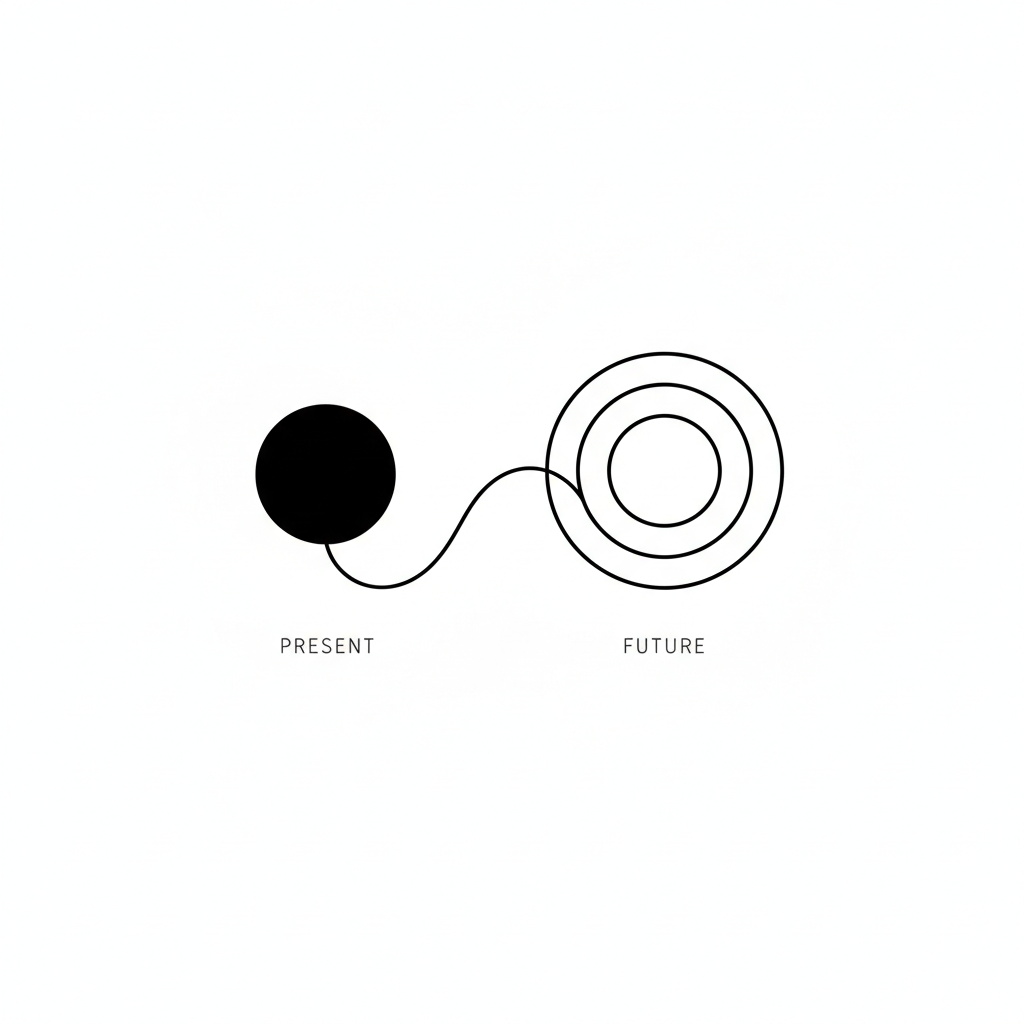
    Why We Choose Wrong

    Most decisions are made from today’s perspective.

    We focus on what feels comfortable now. What feels safe. What other people might think. What could go wrong next month.

    This short-term lens leads to predictable choices: we avoid difficult conversations, stay in situations that aren’t working, and let fear decide for us.

    Then the years pass, and we wonder why we played it so safe.

    The Framework

    Jeff Bezos used this when deciding to start Amazon. He had a comfortable Wall Street job. Leaving to sell books online seemed crazy in 1994.

    So he imagined himself at 80, looking back. He realized he wouldn’t regret trying and failing. But he’d definitely regret never trying.

    That made the decision simple.

    Here’s how it works:

    Step 1: Project yourself to 70 or 80

    Get far enough from today that short-term concerns fade.

    Step 2: Look back at this decision

    Imagine this choice is now part of your history.

    Step 3: Ask which option you’d regret less

    Not which worked out better. Which would you regret less?

    What Changes from That Perspective

    Short-term discomfort disappears
    The awkward conversation? Your future self won’t remember it. The temporary pay cut? Barely a footnote.

    What remains is whether you let short-term discomfort stop you from doing something meaningful.

    Other people’s opinions fade
    At 70, you won’t care what colleagues thought about your career change. You won’t remember who judged your choices.

    You will care whether you lived according to your values or performed for others.

    Inaction creates deeper regret
    Research on end-of-life regrets is clear: people regret what they didn’t do far more than what they did.

    They regret not starting the business, not travelling, not having the conversation, not taking the risk.

    Failed attempts become stories. Avoided attempts become haunting questions.

    Other people’s opinions fade

    At 70, you won’t care what your colleagues thought about your career change. You won’t remember who judged your choices.

    You’ll care whether you lived according to your values or performed for others.

    Inaction creates deeper regret

    Research on end-of-life regrets is consistent: people regret what they didn’t do far more than what they did.

    They regret not starting the business. Not traveling. Not having the conversation. Not taking the risk.

    Failed attempts become stories. Avoided attempts become haunting questions.

    When to Use This

    Use it for decisions that:

    • Have long-term consequences
    • Involve choosing between security and growth
    • Require you to define what matters to you
    • Still feel stuck despite analysing them thoroughly

    Real Applications

    Career crossroads

    You’re 35 with a stable job. A former colleague wants you to join their startup. Risky, but exciting.

    Your future self doesn’t care about the steady paycheck. They care whether you spent your prime working years playing it safe or pursuing something meaningful.

    Relationship decisions

    You know the relationship isn’t working, but leaving feels scary. Kids, finances, social ties make it complicated.

    At 70, will you regret the temporary difficulty of a split, or two decades of quiet unhappiness?

    Difficult conversations

    You need to set boundaries with a parent, confront a partner, or address conflict with a business partner.

    Your future self won’t remember the awkwardness. They’ll remember whether you spoke up or stayed silent for years.

    Time with family

    Your kids are young. Your parents are aging. Work is demanding. Something has to give.

    When you’re old, you won’t wish you’d attended more meetings. You’ll wish you’d been present for the moments that mattered.

    What It Reveals

    This framework doesn’t tell you the “right” answer. It clarifies what you actually value.

    Sometimes you’ll realise the safe choice aligns with your values. That’s fine. Your future self will respect that.

    Other times you’ll see you’re choosing comfort over growth, approval over authenticity, fear over meaning.

    That’s uncomfortable. But it’s clarifying.

    The Practice

    When you’re stuck on something important:

    Close your eyes. Imagine you’re 70, looking back at today.

    What does that version of you want you to know?

    The answer usually comes quickly. And it’s usually different from what you’ve been telling yourself.

    What I’ve Learned

    I’ve used this for a decade. It’s helped me leave jobs, start projects, have hard conversations, and make changes I was afraid to make.

    Not everything worked out perfectly. Some choices were harder than expected. Some failed.

    But I don’t regret any of them.

    What I’d regret is not trying. Playing small because I was afraid of discomfort or judgment or failure.

    You’re in your 30s or 40s. You still have decades ahead. But you’re also old enough to see how quickly years pass. How easy it is to postpone. How much you’ve already compromised.

    Your future self is already living with the consequences of today’s choices.

    Try using the framework today on one decision you’ve been avoiding.
  • How to Make AI Actually Useful (Instead of Frustrating)

    I tried using AI to draft a project update email last month. After 20 minutes of back-and-forth, I gave up and wrote it myself.

    The AI kept giving me something too formal, then too casual, then too long. I spent more time editing its output than if I’d just started from scratch.

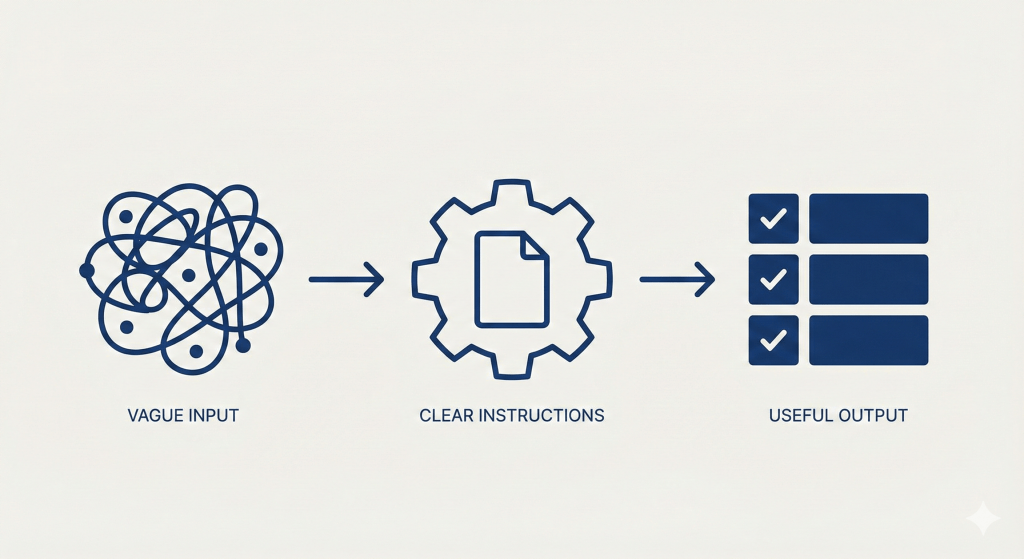
    That’s when I realized the problem. I wasn’t giving the AI clear enough instructions about what I actually wanted.

    After weeks of testing different approaches, I found five patterns that work. Here they are.

    1. Specify the Role and Format

    Instead of this: “Write an email about the project delay”

    Do this: “You’re a project manager. Write 3 bullet points (max 12 words each) explaining the delay, then one 30-word paragraph with next steps.”

    Why it works: The AI knows exactly what you need. No guessing, no editing, ready to use.

    When to use it: Emails, summaries, any routine communication


    2. Show an Example

    Instead of this: “Summarize this article”

    Do this: “Summarize this article using this format: [Paste an example summary you like]

    Now apply the same format to this article: [Paste new article]

    Why it works: AI copies examples better than it follows descriptions.

    When to use it: Anything where you need consistent output—meeting notes, reports, weekly updates


    3. Include the Source Text

    Instead of this: “Summarize our Q3 numbers”

    Do this: “Here’s the Q3 report: [Paste full text]

    Summarize the top 3 metrics in bullet points.”

    Why it works: Without source text, AI invents plausible-sounding details. With it, answers stay accurate.

    When to use it: Any task where facts matter—reports, meeting notes, data analysis


    4. Save Templates for Repeat Tasks

    Once you find a prompt that works, save it.

    I have templates for:

    • Meeting notes
    • Email drafts to my team
    • Weekly progress summaries
    • Breaking projects into tasks

    Now when I need meeting notes, I don’t start from scratch. I use my template, drop in the transcript, done.

    How to start: Build one template this week for one task you do regularly. Test it. Save it. Reuse it.


    5. Keep It Simple First

    Instead of this: A 200-word prompt with detailed step-by-step instructions

    Do this: “You’re a business analyst. List the 5 most important insights from this data.”

    If the output isn’t good enough, then add detail.

    Why it works: Simple often works better. You can always make it more complex if needed.

    When to use it: When starting any new type of prompt


    Real Example: My Project Status Template

    This is what I actually tried:

    You're a project manager preparing a weekly status report for leadership.
    
    I'm pasting updates from my team below. Create a status summary with:
    
    1. Overall status: On Track / At Risk / Blocked (pick one and explain why in 15 words)
    
    2. Progress this week: 3 completed items (one line each)
    
    3. Blockers: Top 2 issues preventing progress (include what's needed to unblock)
    
    4. Next week priorities: 3 critical items
    
    Format: Use bullet points. Keep total under 200 words. Be specific, not vague.
    
    [Paste team updates here]

    This turns scattered updates from my team into one executive-ready report in 60 seconds. Before this template, I spent 30 minutes every Friday doing it manually.


    How to Start

    Pick one task you do every week:

    • Email drafts
    • Meeting summaries
    • Task lists
    • Status updates

    Create one prompt for it. Test it twice. Adjust. Save.

    That’s one template that saves you 10 minutes each time.

    Next week, make another.

    In a month, you’ll have 4-5 templates that actually work.

    The goal isn’t using AI for everything. It’s using it well for repetitive work—so you can focus on things that need your actual thinking.

  • Overcoming Worry: A Course Summary

    I recently completed a comprehensive 7-week course on overcoming worry and generalised anxiety using Cognitive Behavioural Therapy (CBT) techniques. This course has transformed how I understand and manage my worries, and I wanted to share what I learnt here for anyone else struggling with excessive worry (and future myself).

    Table of Contents


      📚 Understanding CBT: The Foundation

      CBT is an active, practical treatment that focuses on the “here and now.” It’s not something done to you—it’s about becoming your own expert in managing your mood.

      What CBT Is and Isn’t

      ✅ CBT IS❌ CBT IS NOT
      Evidence-based and effectiveSomething done to you passively
      Problem-solving focusedJust “thinking positive”
      Practical skills you can useAbout complaining about problems
      Requires active participationA quick fix without effort
      Practice outside sessionsEffective without doing the work

      Key principle: CBT only works if you do the work. It requires commitment, practice, and willingness to try new approaches.


      🧠 What Is Worry and Why Do We Do It?

      Worry and anxiety are normal human responses to perceived threats. A small amount can even be helpful—motivating us to prepare for exams or protecting us from danger.

      When Does Worry Become a Problem?

      Normal anxiety becomes generalised anxiety when it is:

      ✗ Excessive
      ✗ Feels uncontrollable  
      ✗ Intrusive and persistent
      ✗ Causes significant distress
      ✗ Impairs daily functioning

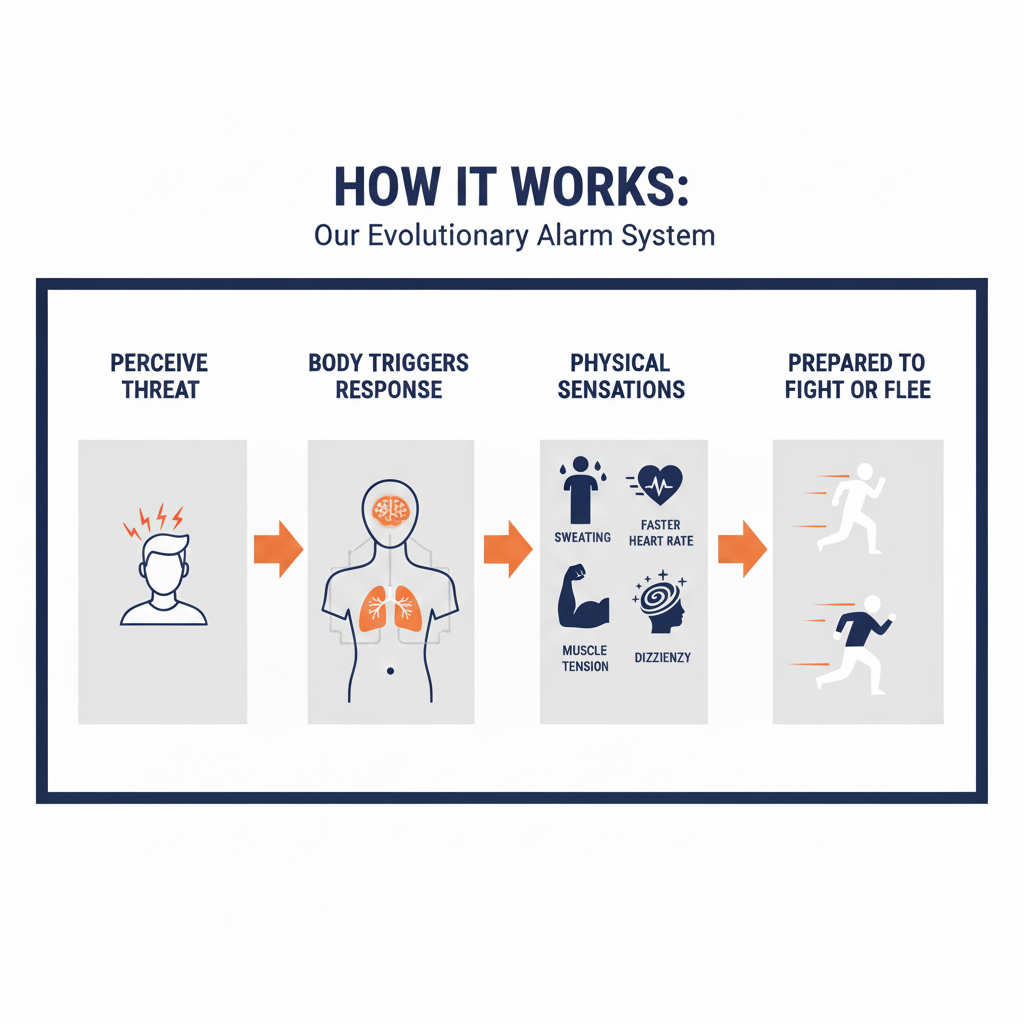
      🚨 The Danger Brain: Our Evolutionary Alarm System

      Our bodies evolved with a “fight or flight” response to keep us safe from life-threatening dangers.

      The modern problem: This oversensitive alarm system gets triggered by daily stressors rather than actual life-or-death situations. Since we can’t physically fight or run away from most modern stressors, we worry as a way to cope.


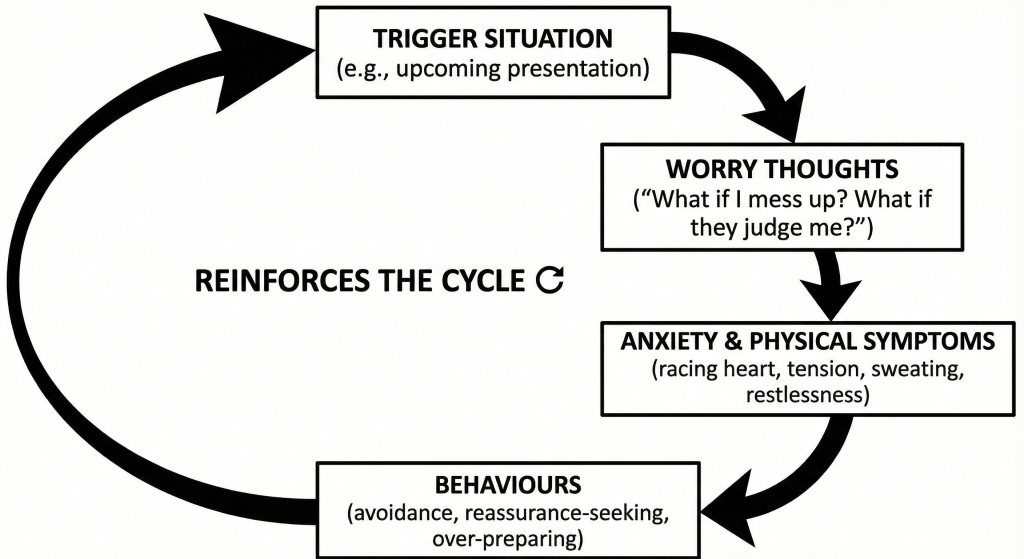
      🔄 The Worry Cycle: Understanding What Keeps Us Stuck

      💭 Beliefs About Worry That Keep Us Stuck

      POSITIVE Beliefs (Why we keep worrying)NEGATIVE Beliefs (Why worrying feels bad)
      “Worrying helps me cope with things”“Worrying is dangerous and will harm me”
      “If I keep worrying, bad things won’t happen”“I can’t control my worrying”
      “Worrying helps me solve problems”“It will never stop”
      “Worrying motivates me to act”“I’ll have a breakdown if I keep worrying”
      “Worrying prepares me for anything”“My worrying will take over completely”

      Critical insight: If we believe worry serves a purpose or prevents bad outcomes, we’ll continue doing it. Challenging these beliefs is essential to breaking free.


      🔍 Two Types of Worries: A Critical Distinction

      Understanding this difference is fundamental to managing worry effectively:

      🌫️ HYPOTHETICAL WORRIES🔧 PRACTICAL PROBLEMS
      About things that might happen in the futureAbout current situations we can address
      Not within our current controlHave possible solutions
      Often start with “What if…?”Can be tackled with problem-solving
      Can spiral endlesslyHave concrete action steps
      Examples:Examples:
      • “What if I get ill?”• “I don’t have enough money to pay my phone bill”
      • “What if my partner dies in an accident?”• “I have two deadlines due next Friday”
      • “What if I fail?”• “My car needs repairing”

      🌳 The Worry Tree: Your Decision-Making Tool

      When a worry enters your mind, use this simple flowchart:

                          ┌─────────────────────┐
                          │   WORRY APPEARS     │
                          └──────────┬──────────┘
                                     ↓
                          ┌─────────────────────┐
                          │ Can I do something  │
                          │  about this NOW?    │
                          └──────────┬──────────┘
                                     ↓
                          ┌──────────┴──────────┐
                          ↓                     ↓
                  ┌──────────────┐      ┌──────────────┐
                  │      NO      │      │     YES      │
                  │ (Hypothetical│      │  (Practical  │
                  │    worry)    │      │   problem)   │
                  └──────┬───────┘      └──────┬───────┘
                         ↓                     ↓
              ┌──────────────────┐   ┌──────────────────┐
              │ DISENGAGE from   │   │ USE PROBLEM      │
              │ the worry using: │   │ SOLVING:         │
              │ • Worry time     │   │ • Define it      │
              │ • Refocusing     │   │ • Brainstorm     │
              │ • Visualization  │   │ • Choose action  │
              │ • Let it pass    │   │ • Plan & do it   │
              └──────────────────┘   └──────────────────┘
      

      🛠️ Disengagement Strategies for Hypothetical Worries

      Since hypothetical worries are about uncertain futures we can’t control, we need to learn to disengage:

      1️⃣ Worry Time

      • What: Set aside 15-30 minutes daily at the same time/place for dedicated worrying
      • How: When worries pop up during the day, postpone them to your worry time
      • Why: Teaches you that you can control when you worry

      2️⃣ Worry Notepad

      • What: Write down worries when they arise, then set them aside
      • How: Keep a notebook handy, jot down the worry, close the book
      • Why: Externalizes the worry and gives permission to let it go temporarily

      3️⃣ Attention Control Training

      Exercise: When you notice yourself worrying, redirect attention to:

      SenseWhat to Notice
      👁️ SightColours, shades, shapes, shadows, lines, edges
      👂 SoundDistant sounds, close sounds, how you’d describe them
      🤚 TouchTextures, temperatures, surfaces
      👃 SmellAny scents in your environment
      👅 TasteWhat you can taste right now

      Result: Focusing on the present naturally reduces anxiety levels.

      4️⃣ Creative Techniques

      TechniqueHow It WorksWhy It Helps
      Singing ItSing your worry to a funny tune (Go Compare advert)Breaks the negative meaning
      RepetitionSay the key word over and over (“weather, weather, weather…”)Makes worry lose meaning
      Funny VoiceImagine Kermit the Frog saying your worryReduces emotional impact
      VisualizationPicture yourself calm and confident in the situationCreates positive mental rehearsal

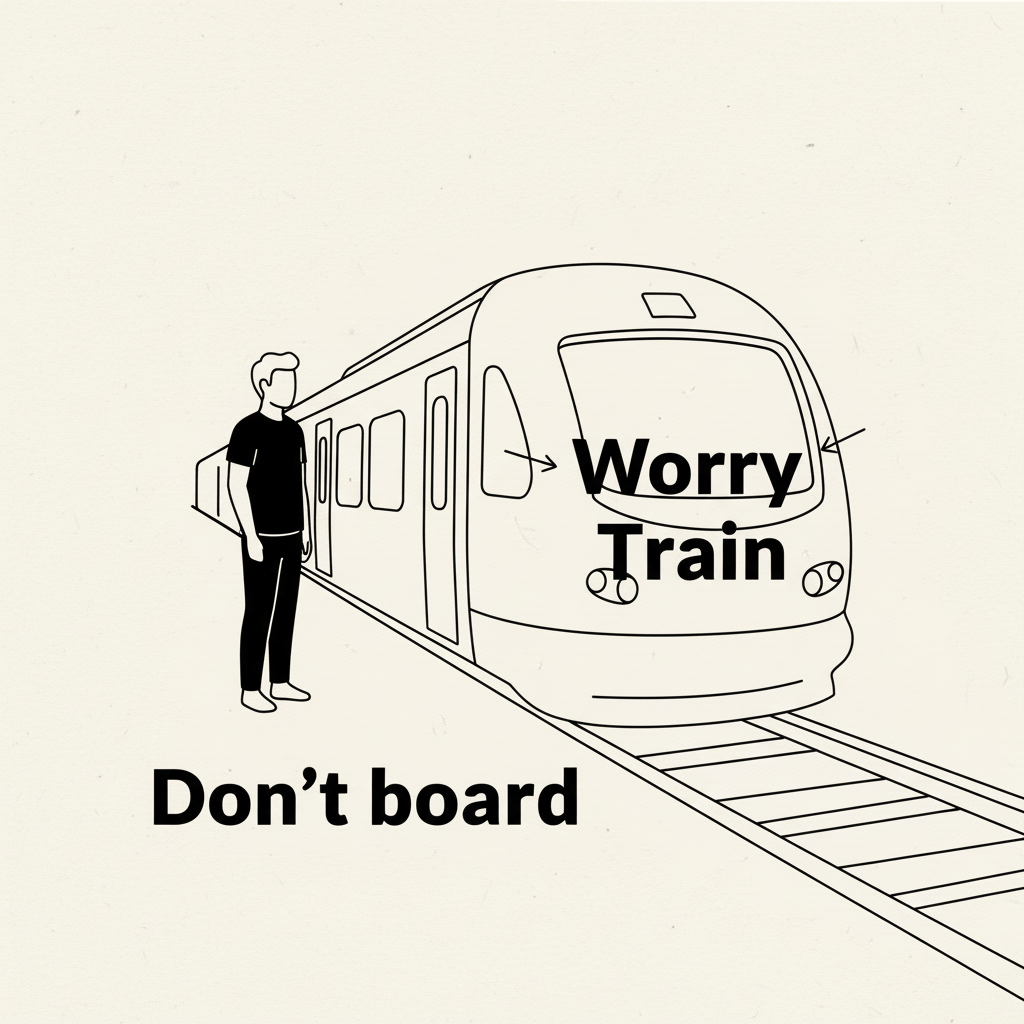
      5️⃣ The Train Metaphor

      (Observing thoughts without engaging)

      Key: You don’t need to board every train of thought. Let unhelpful worries pass by.


      🔤 The 4 U’s of Hypothetical Worry

      Categorize your hypothetical worries to help let them go:

      CategoryQuestion to AskExample
      UnimportantDoes this truly matter in the bigger picture?Worrying about a minor social faux pas from last week
      UnlikelyWhat’s the actual probability?“What if a meteor hits my house?”
      UncertainCan this be predicted or known?“What if the weather is bad next month?”
      UncontrollableIs this within my sphere of influence?“What if there’s a recession?”

      🎲 Tolerating Uncertainty: The Core Challenge

      People who worry excessively struggle with uncertainty. We try to eliminate it through various behaviours:

      Common Certainty-Seeking Behaviours

      BehaviourExampleWhy It’s Problematic
      🚫 Avoidance/ProcrastinationNot opening post to avoid bad newsEliminates uncertainty temporarily but increases anxiety
      🤝 Excessive Reassurance-SeekingRepeatedly asking “Are you sure?”Never truly reassures, creates dependence
      📝 Making ListsMultiple detailed to-do lists dailyTime-consuming, prevents action
      ✔️✔️ Double CheckingChecking locked door 5+ timesErodes confidence in own judgment
      👎 Refusing to Delegate“Only I can do it right”Exhausting, prevents growth
      📚 Over-PreparingPreparing for every possible scenarioWastes time and energy
      😶 Avoiding ConflictNever disagreeing with anyoneSuppresses authentic self
      🏃 Never RelaxingStaying constantly busyUses distraction to avoid feelings
      💭 Worrying“If I worry, I’m preparing”Creates illusion of control

      The problem: These behaviours keep us engaged with uncertainty, maintain anxiety, don’t solve anything, and erode our confidence.

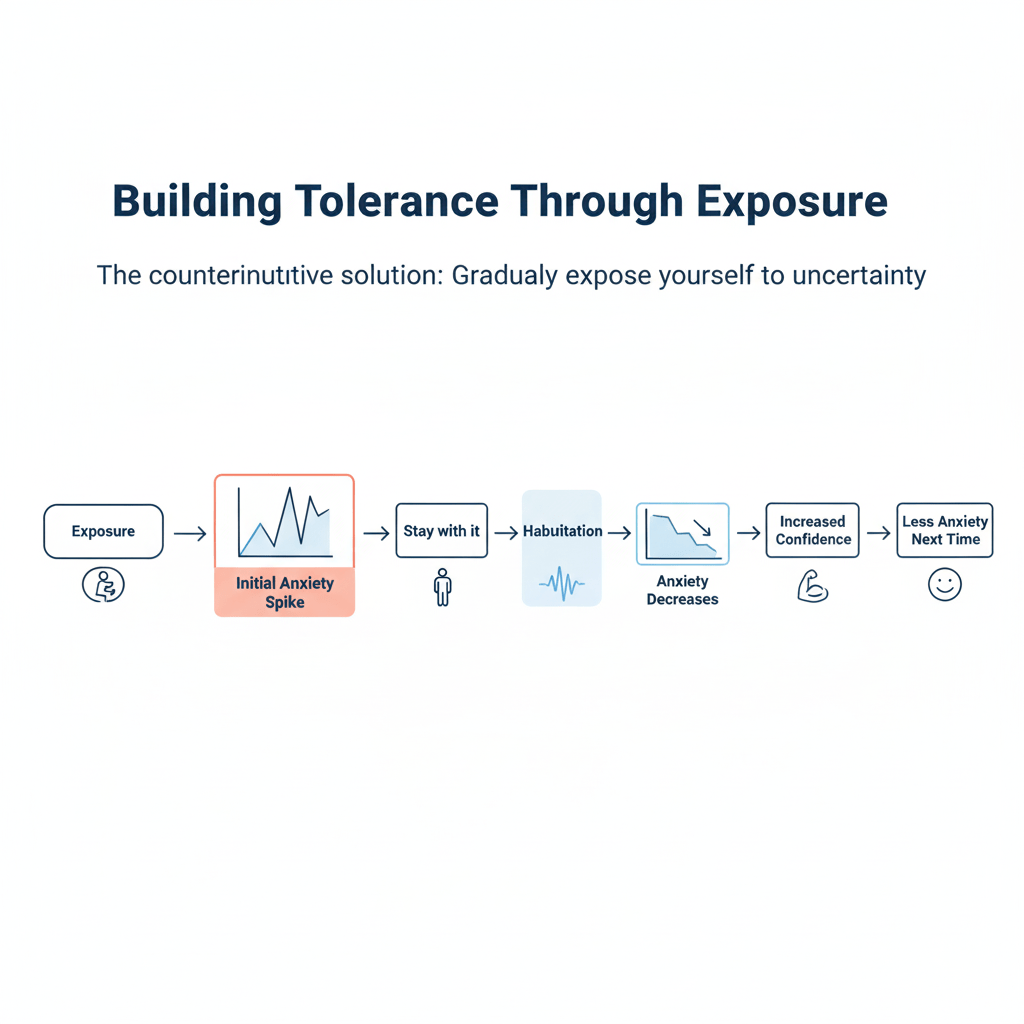
      📈 Building Tolerance Through Exposure

      The counterintuitive solution: Gradually expose yourself to uncertainty

      How it works:

      Exposure → Initial Anxiety Spike → Stay with it → Habituation →
      Anxiety Decreases → Increased Confidence → Less Anxiety Next Time

      🎯 Practical Exposure Goals

      Unhelpful BehaviourExample Goal
      Avoidance/procrastination“I will go to the supermarket I’ve been avoiding and shop for 20 mins”
      Reassurance seeking“I will send one email without getting someone to check it first”
      List making“I will only make one to-do list per day”
      Double checking“I will check I’ve locked the door one fewer time each day”
      Refusing to delegate“I will ask John to do the filing and I won’t check his work”
      Over-preparing“I will only prepare for the most likely scenario”
      Avoiding conflict“If I disagree with someone this week, I will tell them”
      Never relaxing“I will spend 20 minutes in the bath with no distractions”

      Remember: Start small and build up gradually. Anxiety will peak, then naturally decrease.


      🧘 Understanding Automatic Thoughts

      The White Rabbit Experiment

      Try this: Don’t think about a white rabbit for 30 seconds.

      Result: Nearly impossible, right? If a meaningless image is hard to suppress, imagine how much harder it is to push away thoughts that have emotional significance.

      Key insight: Don’t try to suppress worrying thoughts (it backfires). Instead, find balance—use disengagement strategies while allowing thoughts to exist without fighting them.

      Negative Automatic Thoughts (NATs) vs Worries

      🗣️ Negative Automatic Thoughts🌪️ Worries
      Negative self-statementsFuture-focused “what if” scenarios
      “I’m not good enough”“What if I lose my job?”
      “I’m a failure”“What if someone gets ill?”
      “People don’t like me”“What if something bad happens?”
      “I’m worthless”“What if I can’t cope?”

      Important: Both types of thoughts don’t have any more truth than neutral automatic thoughts—they just feel more significant because of their emotional charge.


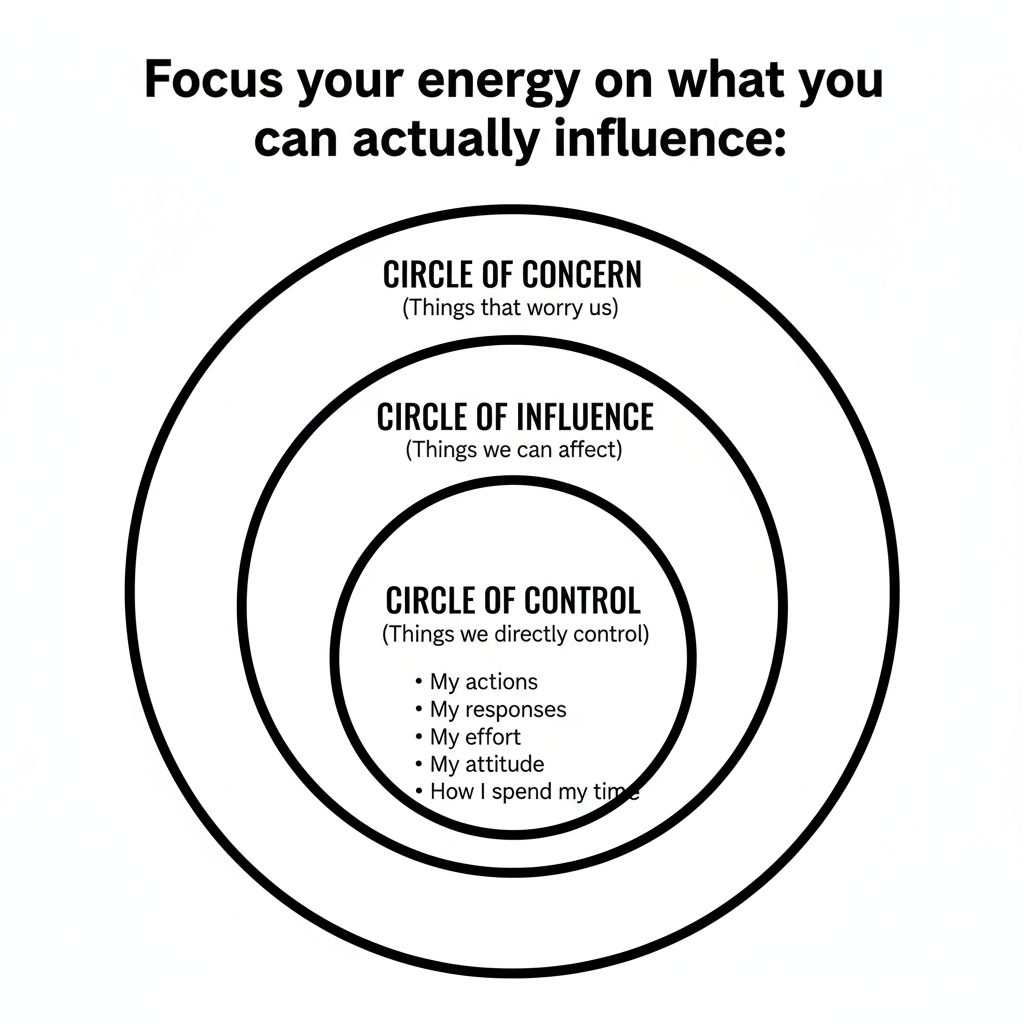
      ⭕ The Circle of Control

      Focus your energy on what you can actually influence:

      Proactive vs Reactive Thinking

      💪 Proactive (Within Your Control)😰 Reactive (Outside Your Control)
      “I can deal with unexpected things”“If only I had more time”
      “I can be more organised”“If only other people did things properly”
      “I can be more understanding”“I’d be happy if X happened”
      “I can do more of what I enjoy”“If I can just prevent things going wrong”

      Your daily energy is limited. Spending it on things outside your control leaves nothing for what matters and can be changed.


      🎭 Common Unhelpful Thinking Styles

      Thinking StyleWhat It IsExampleChallenge It
      🔮 Mind ReadingAssuming you know what others think“She thinks I’m useless”How do you know? Has she told you?
      ⚫⚪ All or NothingBlack and white thinking, no middle ground“I need to get it all right or I’ve failed”Are things really this extreme?
      📉 Fortune TellingPredicting negative futures as certainties“My partner will leave me”Can you really predict the future?
      💥 CatastrophisingTreating ordinary events as disasters“I’ve got a cold, I might end up in hospital”Is worst case really most likely?
      💔 Emotional Reasoning“I feel it, therefore it must be true”“I feel low, it’s going to be a bad day”Mood is variable, not a reflection of reality
      👈 PersonalisingTaking responsibility for things outside your control“It’s my fault things are going wrong”What else was involved?
      🔍 Mental FilterNoticing only negative information“Everyone else is coping, why can’t I?”Are you ignoring contrary evidence?
      Discounting PositiveDismissing accomplishments“Everyone responded well to my presentation, but I noticed a spelling mistake”Are there positives you’re ignoring?
      📏 Should/Must ThinkingUnrealistic pressure on yourself“I should be able to keep my house clean”Where do these rules come from? Do they help?
      👥 Compare and DespairMeasuring yourself against others“Everybody else is coping”Do you really have the full picture?
      🔁 Overgeneralising“This happened once, it will always happen”“Every time I go out, I’ll embarrass myself”Is this assumption based on evidence?

      🧩 Problem-Solving for Practical Worries

      When you identify a practical problem (not a hypothetical worry), use this six-step approach:

      When you identify a practical problem (not a hypothetical worry), use this six-step approach:

      1. Define the problem – Be specific and SMART (Specific, Measurable, Achievable, Relevant, Time-bound)
      2. Brainstorm solutions – List as many options as possible without judging
      3. Decide on an option – Weigh advantages and disadvantages
      4. Plan it – Create clear, actionable steps
      5. Do it – Put your plan into action
      6. Review – Did it work? What did you learn? Adjust if needed

      📊 Cost-Benefit Analysis Template

      SolutionAdvantages ✅Disadvantages ❌
      Option A
      Option B
      Option C

      🫁 Managing Physical Symptoms: Breathing and Relaxation

      Controlled Breathing Technique

      When anxious, we often breathe rapidly and shallowly, disrupting the oxygen-carbon dioxide balance and worsening physical symptoms.

      Simple 5-2-8 Technique:

      1. Place one hand on your chest, one on your abdomen
      2. Breathe in slowly through your nose (count to 5)
      3. Hold briefly (count to 2)
      4. Breathe out slowly through your mouth (count to 8)
      5. Repeat for several minutes

      Focus on the counting to redirect attention from anxiety triggers. This re-establishes your body’s natural balance.

      Progressive Muscle Relaxation

      Work through each body part systematically:

      Head & Face → Neck → Shoulders → Arms & Hands → 
      Back → Chest & Abdomen → Hips → Legs → Feet
      
      For each area:
      1. Notice any tension
      2. Consciously release it
      3. Feel the relaxation spreading
      

      😴 Sleep: The Often-Disrupted Function

      Understanding Sleep

      Two processes control our sleep:

      1. Homeostasis: The more active we are, the more sleep pressure builds (like hunger for sleep)
      2. Circadian Rhythm: Our 24-hour body clock
        • Cortisol (morning) → Wakes us up
        • Melatonin (evening) → Makes us sleepy
        • Blue light from devices → Delays melatonin

      Sleep Cycle Chart

        AWAKE ────────────────────────────────────────
        Stage 1  ↓ Light sleep
        Stage 2  ↓ ↑
        Stage 3  ↓ ↑ Deep sleep
        REM      ↓ ↑ ← MOST IMPORTANT (restorative)
                 
                 └─ 90-minute cycle repeats throughout night
                 
        Interruptions reset to Stage 1!
      

      Key point: If interrupted frequently, you never reach restorative REM sleep.

      🛏️ Sleep Hygiene Essentials

      Body:

      • Stop caffeine 4+ hours before bed
      • Avoid alcohol (disrupts later sleep stages)
      • Don’t eat large/spicy meals late
      • Exercise daily, but not within 2 hours of bedtime

      Environment:

      • Keep bedroom cool, dark, and quiet
      • Use the bedroom for sleep and sex only
      • Remove phones and technology
      • Make it comfortable and pleasant

      Routine:

      • Keep consistent sleep and wake times (even weekends)
      • Avoid daytime naps
      • Create a wind-down routine (warm bath, calming drink, reading)
      • Avoid screens before bed (blue light delays melatonin)

      ⏰ The 30-Minute Rule

      Can't sleep after ~30 minutes?
                 ↓
      Get up, go to another room
                 ↓
      Do quiet, relaxing activity
                 ↓
      Return to bed only when sleepy
                 ↓
      Still can't sleep after 30 mins? Repeat!
      

      Why: Prevents associating your bed with wakeful anxiety.

      Important tips:

      • 🚫 Stop clock-watching! It only increases anxiety. Turn the clock away.
      • 💤 Everyone needs different amounts of sleep (6-9 hours). The “8-hour rule” is a myth.
      • 📝 Worried about things? Write them down, deal with them in the morning.

      ⏱️ Time Management and Prioritisation

      The Urgent/Important Matrix

      URGENTNOT URGENT
      IMPORTANT🔴 DO IMMEDIATELY Crisis, deadlines, pressing problems🟢 SCHEDULE & PRIORITISE Planning, prevention, development ← Most effective focus
      NOT IMPORTANT🟡 DELEGATE IF POSSIBLE Interruptions, some emails/callsELIMINATE/MINIMISE Time wasters, busy work

      🏔️ Mountains into Molehills Strategy

      Large overwhelming task?

      1. Break it down into smallest possible steps
      2. Prioritise steps by importance
      3. Do one step at a time
      4. Don’t move on until current step is done
      5. Cross off completed steps (rewarding!)
      6. Keep updated list (helps you sleep better knowing there’s a plan)

      Example:

      • ❌ “Write report” (overwhelming!)
      • ✅ “Open document” → “Write introduction paragraph” → “Research section 1” → “Draft section 1” → etc.

      🎯 Planning for the Future: Maintaining Progress

      🚨 Know Your Early Warning Signs

      AreaWarning Signs
      Thoughts“Here we go again”, catastrophising returns, negative self-talk increases
      FeelingsIncreased anxiety, irritability, low mood, overwhelmed
      PhysicalTension, fatigue, sleep problems, restlessness
      BehavioursAvoidance returning, excessive checking, withdrawing from activities

      🧰 Your Worry Management Toolbox

      Problem TypeTools to Use
      Hypothetical worriesWorry tree, worry time, attention refocusing, visualization, train analogy
      Physical symptomsBreathing exercises, progressive muscle relaxation
      UncertaintyReduce certainty-seeking behaviours, exposure practice
      Practical problemsSix-step problem solving
      Time pressurePrioritisation matrix, breaking tasks down
      Negative thoughtsIdentify unhelpful thinking styles, challenge them

      📋 Setback Response Plan

      1. Notice early warning signs
              ↓
      2. Identify the trigger situation
              ↓
      3. Review which tools worked best
              ↓
      4. Re-read relevant handouts
              ↓
      5. Practice techniques that helped before
              ↓
      6. Use worry diary to track patterns
              ↓
      7. Schedule regular review days
      

      🎓 Key Takeaways

      ✨ The Core Principles

      1. CBT requires active participation Practice is essential—these are skills that improve with use.
      2. Distinguish between hypothetical worries and practical problems They require completely different approaches.
      3. Don’t try to suppress worries It backfires. Instead, learn to disengage or tolerate them.
      4. Challenge your beliefs about worry Worrying doesn’t prevent bad things or help you cope—it keeps you stuck.
      5. Build tolerance for uncertainty gradually Drop safety behaviours, expose yourself to discomfort, trust that anxiety will naturally decrease.
      6. Focus energy on what you can control Let go of trying to control the uncontrollable.
      7. Practice self-compassion This is a journey, not a destination. Setbacks are normal and part of learning.

      🌟 Final Thoughts

      Recovery from excessive worry isn’t about never worrying again—it’s about changing your relationship with worry. It’s about:

      • ✅ Recognising when worry serves no purpose
      • ✅ Having tools to manage it effectively
      • ✅ Building confidence that you can handle uncertainty
      • ✅ Focusing energy where it matters most

      Remember:

      The techniques in this course WORK, but they require CONSISTENT PRACTICE.

      • Be patient with yourself
      • Celebrate small victories
      • Learn from setbacks
      • Keep practising
        You’re building a skill set that will serve you for life. 💪

      If you found this summary helpful or have gone through similar experiences, I’d love to hear your thoughts and what techniques worked best for you. Feel free to share in the comments below!

    • The Weekly Review: A Simple System to Stay on Track

      I used to feel like I was always busy but never making progress.

      Every Monday started with good intentions. By Friday, I’d look back and wonder where the week went. I was working hard, but I couldn’t tell you what I’d actually accomplished.

      The problem wasn’t effort. It was that I never paused to look at what I was doing.

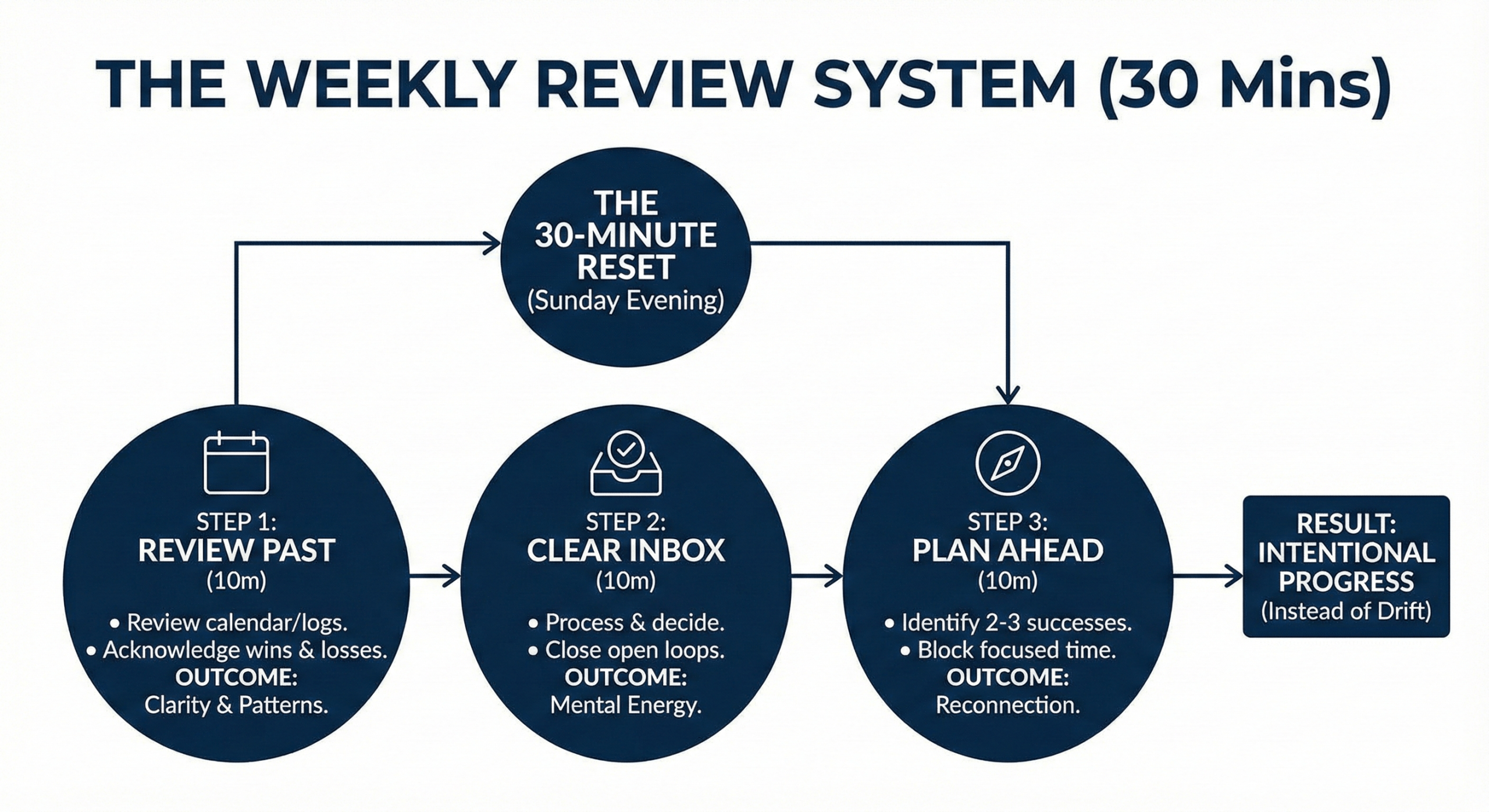
      That changed when I started doing a weekly review. It’s a simple practice—30 minutes every Sunday evening—but it’s the most valuable habit I’ve built in years.

      Why Most People Don’t Review Their Week

      Reflection feels optional. Action feels urgent.

      We tell ourselves we don’t have time to pause and review. We need to keep moving, keep doing, keep producing.

      But here’s what I learned: without reflection, you keep making the same mistakes. You drift without noticing. You work on things that don’t matter because you never stop to ask if they do.

      The weekly review isn’t about doing more. It’s about making sure you’re doing the right things.

      What a Weekly Review Actually Does

      A weekly review serves three purposes:

      It creates closure

      Your brain doesn’t like open loops. Unfinished tasks, unclear commitments, and vague plans all take up mental energy. Even when you’re not actively thinking about them, they’re running in the background.

      The review lets you close loops, get things out of your head, and start the next week with a clear mind.

      It reveals patterns

      When you review your week, you start noticing what actually works and what doesn’t. Which meetings were valuable. Which tasks ate time without producing results. Which days you felt most productive and why.

      Without this regular check-in, these patterns stay invisible.

      It reconnects you to what matters

      It’s easy to spend a week responding to whatever’s urgent and forget what’s actually important. The review helps you course-correct before you drift too far.

      My Weekly Review Process

      I do this every Sunday evening. It takes 30 minutes, sometimes less.

      You can adjust the timing to what works for you—Friday afternoon, Sunday morning, Monday before work. The key is consistency, not perfection.

      Step 1: Review the Past Week (10 minutes)

      I open my calendar and look back at the week that just ended.

      I ask myself:

      • What did I accomplish that mattered?
      • What took more time than it should have?
      • What conversations or decisions were most important?
      • What didn’t get done, and does it still matter?

      I’m not writing essays. Just quick notes. Usually bullet points.

      The goal is to acknowledge what happened—both good and bad—before moving forward.

      Step 2: Clear Your Inbox and Tasks (10 minutes)

      I go through my email inbox, message apps, and task list.

      For each item, I decide:

      • Does this need action? If yes, when?
      • Can someone else handle this?
      • Does this actually matter?

      Most things get deleted, delegated, or scheduled. The rest goes on a “someday” list that I review monthly.

      This step isn’t about doing everything. It’s about getting clarity on what needs attention and what doesn’t.

      Step 3: Plan the Week Ahead (10 minutes)

      I look at my calendar for the coming week and identify:

      • What are the 2-3 outcomes that would make this week successful?
      • What meetings or commitments do I have?
      • Where are my blocks of focused time?

      Notice I’m not planning every task or every hour. I’m just identifying the few things that matter most and making sure I have time protected for them.

      That’s it. Three steps, 30 minutes, once a week.

      What Changed for Me

      Before I started weekly reviews, I was reactive. I’d wake up Monday and respond to whatever was in front of me. By Friday, I’d realize I spent the entire week on other people’s priorities.

      Now, I spend Sunday evening getting clear on what actually matters. When Monday comes, I already know where my energy should go.

      This simple shift changed everything:

      I stopped feeling overwhelmed

      When everything lives in your head, it all feels urgent. The review gets it out of your head and onto paper where you can see it clearly.

      Most of what felt overwhelming turns out to be manageable once you write it down.

      I got better at saying no

      The review forced me to see where my time was actually going. I noticed how many meetings I was attending that didn’t matter. How many favors I was doing that weren’t reciprocated. How many “quick tasks” were adding up to hours.

      Once I saw the patterns, saying no became easier.

      I stopped drifting

      Without regular check-ins, it’s easy to spend weeks on things that don’t align with your goals. You’re busy, but you’re not making progress.

      The weekly review keeps me connected to what I said was important. When I notice drift, I can course-correct quickly instead of waking up months later and wondering what happened.

      I learned from experience

      The review creates a feedback loop. I notice what worked and what didn’t. Which approaches saved time. Which commitments drained energy. Which people helped and which created problems.

      This awareness compounds. You get better at decisions because you’re actually learning from the ones you already made.

      Common Mistakes

      Making it too complicated

      The weekly review isn’t a journaling session or deep soul-searching exercise. It’s a practical check-in. Keep it simple.

      Skipping it when things are busy

      That’s exactly when you need it most. If you can’t find 30 minutes to review your week, that’s a sign you’re not in control of your time.

      Only focusing on what went wrong

      The review isn’t about beating yourself up. Notice what worked, too. What gave you energy. What produced results. Do more of that.

      Not acting on what you learn

      The point isn’t just reflection. It’s using what you learn to make next week better. If you notice a pattern, change something.

      Making It Work for You

      You don’t need to copy my exact process. Adjust it to fit your life.

      Some people prefer Friday afternoon so they can disconnect for the weekend. Others like Monday morning to start fresh. Some do 15 minutes, others do an hour.

      The structure matters less than the consistency.

      What matters is that you pause regularly to:

      • Acknowledge what happened
      • Clear your head
      • Get clear on what’s next

      That’s the core. Everything else is just details.

      Start This Week

      You don’t need a special system or app. Just set aside 30 minutes this Sunday.

      Look back at your week. What mattered? What didn’t? What do you want next week to look like?

      Write down a few notes. Clear your inbox. Identify 2-3 priorities for the coming week.

      That’s it.

      Do that for a month and see what changes. You’ll probably notice you feel more in control, less overwhelmed, and clearer about where your time should go.

      The weekly review won’t solve every problem. But it will help you see your problems more clearly. And that’s usually the first step to solving them.

    • Productivity Isn’t About Doing More—It’s About Doing What Matters

      I used to think productivity meant getting everything done.

      Check off all the tasks. Answer all the emails. Finish the entire list. That was the goal.

      But I always ended the day exhausted and unsatisfied. I was busy for 10 hours straight, yet I couldn’t point to anything meaningful I’d accomplished.

      That’s when I realized the problem wasn’t my time management. It was my inability to identify what actually mattered.

      The Real Problem

      We treat all tasks as equally important. We look at our list and think everything needs to get done today.

      But here’s the truth: most of what’s on your list doesn’t matter. Not really.

      Some tasks create lasting value. Others are just noise. The difference between productive people and busy people is that productive people know how to tell them apart.

      I’ve spent years studying this question: How do you identify what actually matters?

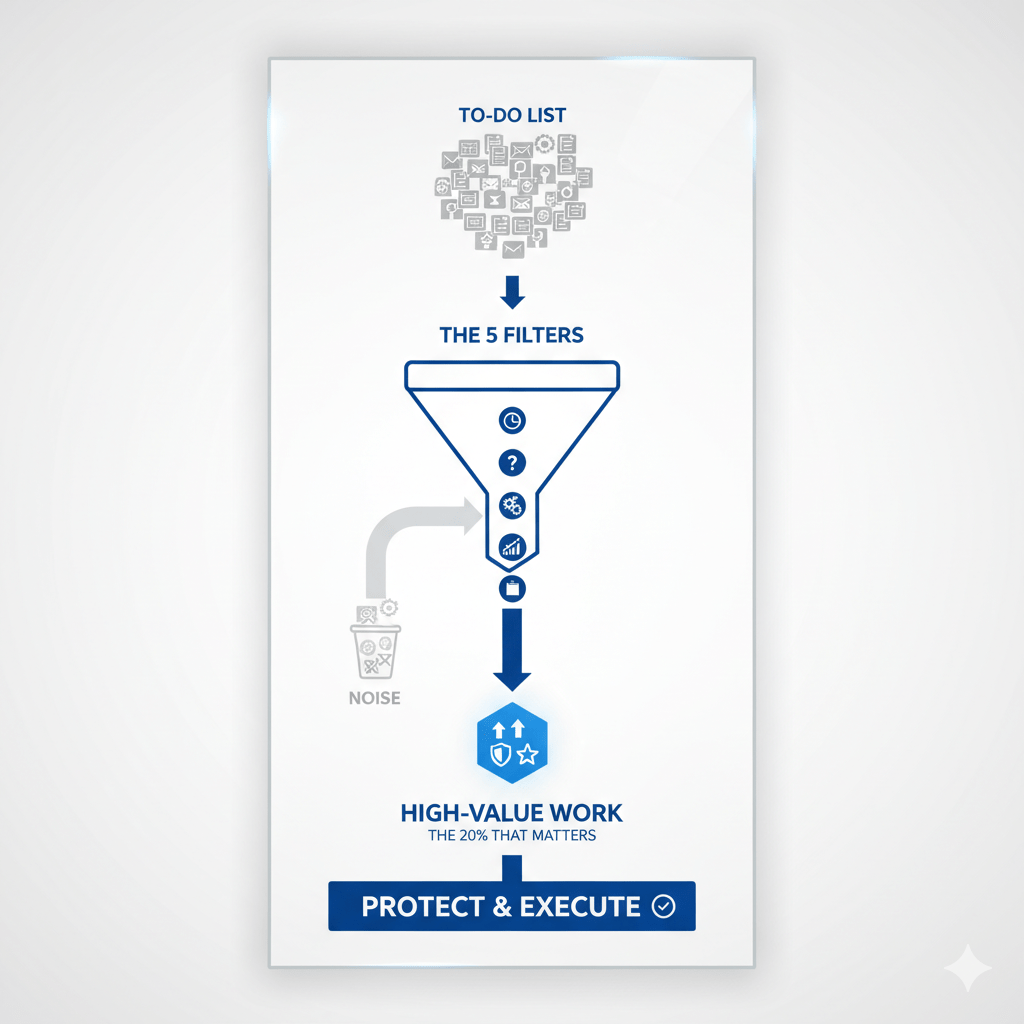
      Here are five filters I use every day.

      FilterKey QuestionAction / Focus
      1. Time Horizon TestWill this matter a month from now?Prioritize work with Long-Term Value (e.g., building a skill, creating assets).
      2. Regret TestWould I regret skipping this task on Friday?Focus on core projects and Difficult, Important work you tend to avoid.
      3. Delegation TestCan only I do this task?Dedicate time to your Unique Value work; delegate or delay the rest.
      4. Compound EffectWill doing this today make tomorrow easier?Choose tasks that Pay You Back Over Time (e.g., building a system, making key decisions).
      5. Energy MatchDoes this task match my current energy level?Match High-Energy tasks (Deep Work) to your peak hours.

      Filter 1: The Time Horizon Test

      Ask yourself: How long will this task matter?

      Will it be relevant tomorrow? Next week? Next month? Next year?

      The longer something matters, the more important it is.

      Responding to a routine email matters today. Tomorrow, you won’t remember it. Building a new skill matters for years. That’s the difference.

      I learned this from looking back at my own weeks. The things I remembered—the things that actually moved my career or life forward—were always the ones with longer time horizons.

      Now, when I’m not sure what to prioritize, I ask: Will I care about this in a month? If the answer is no, it goes to the bottom of the list.

      Filter 2: The Regret Test

      Imagine it’s Friday evening. You’re reflecting on your week.

      Which tasks, if left undone, would you regret?

      Most things won’t pass this test. You won’t regret skipping that optional meeting. You won’t think twice about that email you didn’t send.

      But you will regret avoiding the difficult conversation. You will notice if you didn’t make progress on your main project. You will feel it if you let another week pass without working on what you said was important.

      This question cuts through everything. It shows you what you actually value versus what you’re just reacting to.

      I ask myself this every morning. It takes 30 seconds, and it completely changes how I spend my day.

      Filter 3: The Delegation Test

      Could someone else do this task?

      If yes, it’s probably not where your unique value is.

      This doesn’t mean you won’t do it. Sometimes you have to. But it helps you see which work requires your specific skills or judgment—and which work is just filling time.

      I noticed something about my most productive days: they’re the days when I spent my time on things only I could do. Everything else was either delegated, delayed, or ignored.

      The work that only you can do is usually the work that matters most. It’s also the work that’s easiest to postpone because it’s harder and less urgent than everything else.

      Filter 4: The Compound Effect

      Some work pays you back over time. Other work is done once and forgotten.

      Ask yourself: Will doing this today make tomorrow easier?

      Work that compounds includes building systems, developing skills, creating assets, and making decisions that prevent future problems.

      Work that doesn’t compound includes most emails, most meetings, and most administrative tasks.

      I’ve become obsessed with compound work. Not because I’m trying to optimize everything, but because I’m tired of doing the same low-value tasks over and over.

      When you focus on work that compounds, you gradually reduce your total workload while increasing your output. That’s the only way I know to escape the busy trap.

      Filter 5: The Energy Match

      Not all important work requires the same energy.

      Some tasks need deep focus. Others can be done when you’re half-awake.

      The mistake most people make is trying to do high-energy work when they’re exhausted, or wasting their best hours on low-energy tasks.

      I divide my work into three categories:

      High-energy: Strategic thinking, creative work, complex problem-solving, important writing.

      Medium-energy: Meetings, planning, communication, reviewing work.

      Low-energy: Administrative tasks, organizing, routine follow-ups.

      Then I match the work to my energy throughout the day.

      My peak hours—usually morning—go to high-energy work. When I’m tired in the afternoon, I do low-energy tasks. This simple change doubled my output because I stopped fighting my natural energy patterns.

      How to Use These Filters

      You don’t need to analyze every task in detail. Just pause at the start of your day and ask:

      • Will this matter beyond today?
      • Would I regret not doing this?
      • Can only I do this?
      • Will this make future work easier?
      • Does this match my current energy?

      These questions reveal priorities quickly. You’ll see which 20% of your work drives 80% of your results.

      Then protect time for that 20%. Make it non-negotiable. Everything else can wait, get batched together, or just not get done.

      What I Learned

      When I started using these filters, I realized something uncomfortable: I’d been wasting most of my time.

      I was busy, but I wasn’t productive. I was reacting to whatever seemed urgent instead of focusing on what mattered.

      That hurt to admit. But it also freed me.

      Once I could see the difference clearly, I could change my behavior. I started saying no more often. I protected my mornings for deep work. I stopped measuring success by how many tasks I completed.

      Now I measure it by whether I moved meaningful work forward. Some days, that means completing one important thing instead of twenty unimportant things.

      It feels strange at first. You finish the day with items left on your list. But you also finish knowing you spent your time on what actually mattered.

      That’s the shift. From doing more to doing what matters.

      The filters help you see the difference. The rest is just discipline.

    • Thinking in Bets: Making Decisions When You Can’t Predict Outcomes

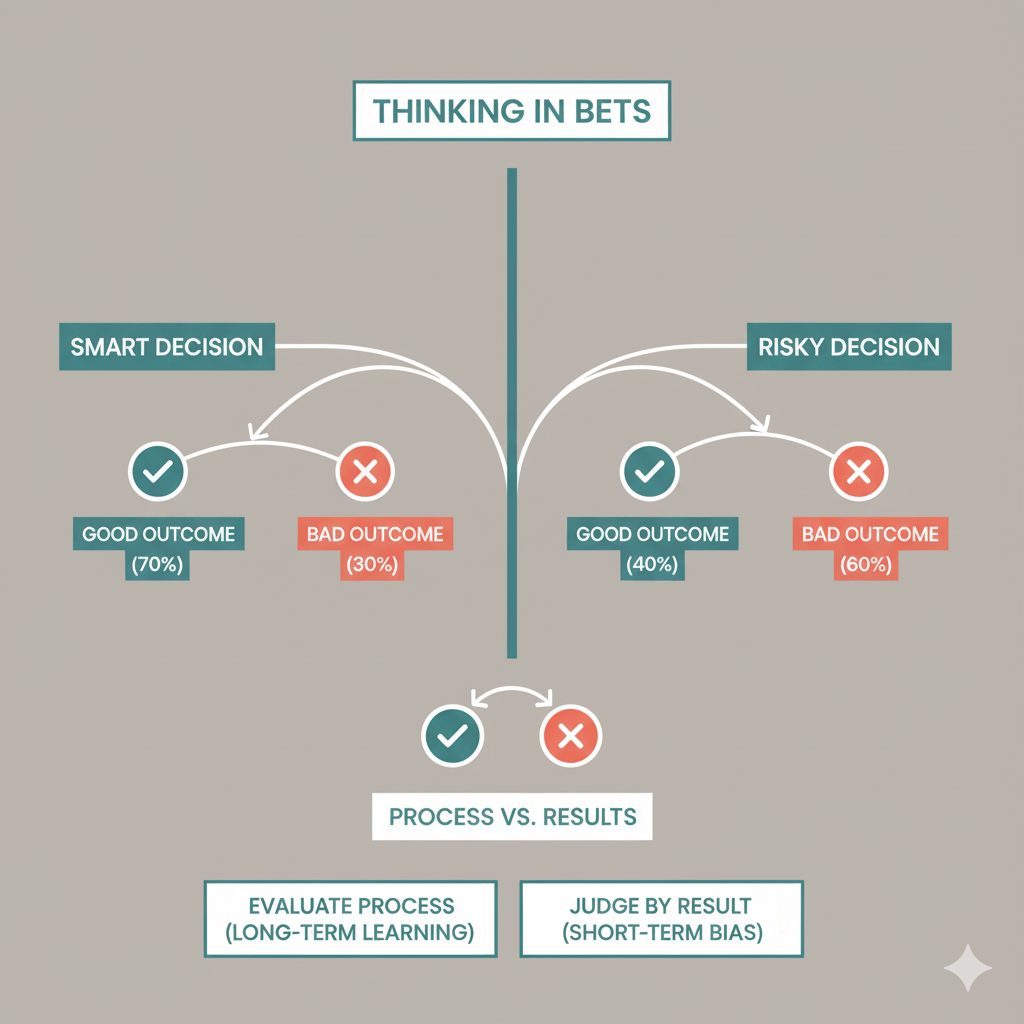
      You can make a terrible decision and get lucky. You can make a smart decision and still lose.

      The quality of a decision and the quality of its outcome are two different things.

      Most people judge their decisions based solely on results. When things go well, they assume their process was sound. When things go poorly, they assume they made a mistake. This creates a misleading feedback loop that keeps them from learning what actually matters.

      The problem is simple: outcomes are probabilistic, not deterministic.

      The Difference Between Process and Results

      Imagine you’re deciding whether to drive home after having two drinks. You feel fine, and it’s only a ten-minute drive. You make it home safely.

      Was that a good decision?

      Most people would say no, even though the outcome was fine. Why? Because you understand that the decision created unnecessary risk. The outcome doesn’t change the quality of the choice.

      Now flip it around.

      You decide to invest in a diversified index fund for retirement. Twenty years later, you would have been better off buying a single tech stock that skyrocketed. Does that mean your diversification strategy was wrong?

      Again, no. The decision was sound based on what you knew and the probabilities involved. You just didn’t get the lucky outcome.

      This is thinking in bets. It’s about evaluating decisions based on the information available at the time and the likelihood of different outcomes, not just what actually happened.

      Why We Struggle with Probabilistic Thinking

      Our brains aren’t naturally wired for probability. We want certainty. We want clear cause and effect.

      This leads to two common mistakes.

      Resulting: Judging a decision based solely on its outcome. If it worked out, it must have been a good decision. If it didn’t, it must have been bad.

      Hindsight bias: After something happens, we convince ourselves it was predictable all along. We retrofit our understanding to match the outcome.

      Both of these patterns keep us from learning what actually matters—the quality of our decision-making process.

      How to Think in Bets

      Thinking probabilistically doesn’t mean you need to calculate exact percentages for every choice. It means shifting how you frame decisions.

      1. Replace Certainty with Likelihood

      Instead of asking “Will this work?” ask “How likely is this to work?”

      Instead of “Is this the right choice?” ask “What’s the probability this leads to a good outcome?”

      This small shift acknowledges uncertainty and helps you weigh options more realistically.

      2. Consider Multiple Possible Outcomes

      Good decisions account for different scenarios, not just the one you hope will happen.

      Before making a choice, map out a few possibilities:

      • Best case scenario
      • Most likely scenario
      • Worst case scenario

      Then ask: Given these possibilities and their likelihood, is this decision worth making?

      3. Separate Decision Quality from Outcome Quality

      After something happens, resist the urge to judge your decision by its result alone.

      Ask yourself:

      • Based on what I knew at the time, was this a reasonable choice?
      • Did I consider the right factors?
      • Was my thinking process sound?

      Sometimes you make a great decision and get unlucky. Sometimes you make a poor decision and get lucky. The goal is to build a process that puts probability on your side over time.

      4. Think in Expected Value

      Expected value is a simple way to compare options when outcomes are uncertain.

      You don’t need complex math. Just think about it like this:

      If you had to make this decision 100 times, what would be the average outcome?

      This helps you see past individual results and focus on what works over the long run.

      Applying Probabilistic Thinking to Real Decisions

      Career Choices

      Should you take a new job offer?

      Instead of agonizing over whether it’s “the right move,” think about probabilities:

      • How likely is it that this role helps you build valuable skills?
      • What’s the probability you’ll enjoy the work?
      • If it doesn’t work out, how easily can you course-correct?

      You’re not looking for certainty. You’re looking for favorable odds.

      Financial Decisions

      Should you buy that house? Invest in that opportunity? Start that business?

      Map out scenarios:

      • If the market shifts, can you handle the downside?
      • What’s the range of possible outcomes?
      • Are you betting an amount you can afford to lose?

      Thinking probabilistically doesn’t eliminate risk. It helps you take smart risks while avoiding reckless ones.

      Relationships and Personal Life

      Should you move to a new city? End a relationship? Make a major lifestyle change?

      These decisions feel too personal for probability, but the framework still helps:

      • What are the different ways this could play out?
      • What information am I basing this on?
      • If I had to give advice to a friend in this situation, what would I say?

      The goal isn’t to remove emotion. It’s to balance intuition with clear thinking.

      The Long-Term Advantage

      Thinking in bets won’t guarantee perfect outcomes. Nothing will.

      But it changes how you learn from experience. Instead of being swayed by luck—good or bad—you build a more accurate understanding of what actually works.

      Over time, this compounds.

      People who think probabilistically make better decisions on average. They don’t get every choice right, but they get more of them right. They learn faster because they evaluate process, not just results.

      Most importantly, they’re less likely to fool themselves. They know that a good outcome doesn’t validate a reckless choice, and a bad outcome doesn’t necessarily mean they were wrong.

      Start Small

      You don’t need to overhaul your entire decision-making process overnight.

      Start by noticing when you judge decisions purely by results. Catch yourself when you think “That worked, so it must have been smart” or “That failed, so it must have been wrong.”

      Then pause and ask: Based on what I knew then, was this decision sound?

      That simple question shifts your thinking from certainty to probability. From hindsight to foresight. From luck to process.

      You might not control outcomes, but you can control the quality of your choices. That’s where your leverage is.

      And over time, better choices lead to better results—not every time, but more often than not.

      That’s the bet worth making.