I used to think productivity meant getting everything done.
Check off all the tasks. Answer all the emails. Finish the entire list. That was the goal.
But I always ended the day exhausted and unsatisfied. I was busy for 10 hours straight, yet I couldn’t point to anything meaningful I’d accomplished.
That’s when I realized the problem wasn’t my time management. It was my inability to identify what actually mattered.

The Real Problem
We treat all tasks as equally important. We look at our list and think everything needs to get done today.
But here’s the truth: most of what’s on your list doesn’t matter. Not really.
Some tasks create lasting value. Others are just noise. The difference between productive people and busy people is that productive people know how to tell them apart.
I’ve spent years studying this question: How do you identify what actually matters?
Here are five filters I use every day.
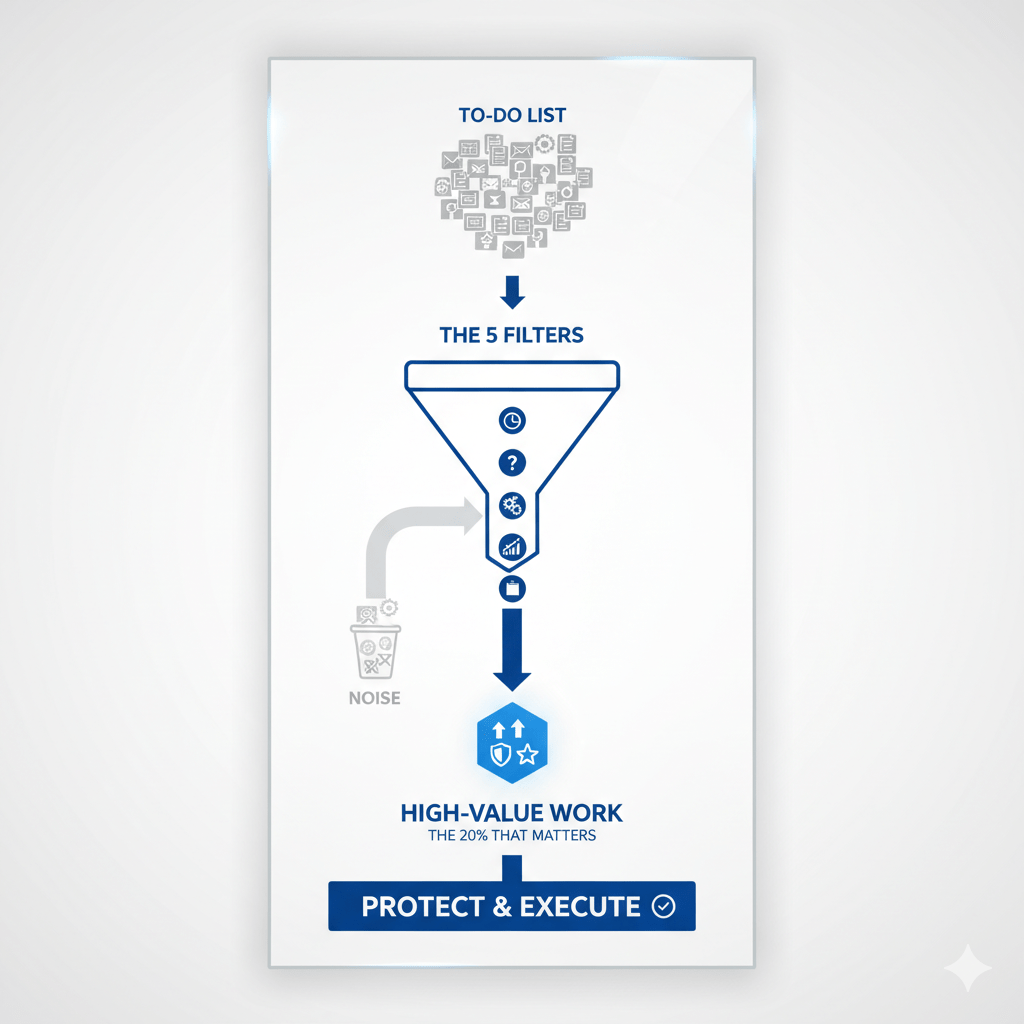
| Filter | Key Question | Action / Focus |
| 1. Time Horizon Test | Will this matter a month from now? | Prioritize work with Long-Term Value (e.g., building a skill, creating assets). |
| 2. Regret Test | Would I regret skipping this task on Friday? | Focus on core projects and Difficult, Important work you tend to avoid. |
| 3. Delegation Test | Can only I do this task? | Dedicate time to your Unique Value work; delegate or delay the rest. |
| 4. Compound Effect | Will doing this today make tomorrow easier? | Choose tasks that Pay You Back Over Time (e.g., building a system, making key decisions). |
| 5. Energy Match | Does this task match my current energy level? | Match High-Energy tasks (Deep Work) to your peak hours. |
Filter 1: The Time Horizon Test
Ask yourself: How long will this task matter?
Will it be relevant tomorrow? Next week? Next month? Next year?
The longer something matters, the more important it is.
Responding to a routine email matters today. Tomorrow, you won’t remember it. Building a new skill matters for years. That’s the difference.
I learned this from looking back at my own weeks. The things I remembered—the things that actually moved my career or life forward—were always the ones with longer time horizons.
Now, when I’m not sure what to prioritize, I ask: Will I care about this in a month? If the answer is no, it goes to the bottom of the list.
Filter 2: The Regret Test
Imagine it’s Friday evening. You’re reflecting on your week.
Which tasks, if left undone, would you regret?
Most things won’t pass this test. You won’t regret skipping that optional meeting. You won’t think twice about that email you didn’t send.
But you will regret avoiding the difficult conversation. You will notice if you didn’t make progress on your main project. You will feel it if you let another week pass without working on what you said was important.
This question cuts through everything. It shows you what you actually value versus what you’re just reacting to.
I ask myself this every morning. It takes 30 seconds, and it completely changes how I spend my day.
Filter 3: The Delegation Test
Could someone else do this task?
If yes, it’s probably not where your unique value is.
This doesn’t mean you won’t do it. Sometimes you have to. But it helps you see which work requires your specific skills or judgment—and which work is just filling time.
I noticed something about my most productive days: they’re the days when I spent my time on things only I could do. Everything else was either delegated, delayed, or ignored.
The work that only you can do is usually the work that matters most. It’s also the work that’s easiest to postpone because it’s harder and less urgent than everything else.
Filter 4: The Compound Effect
Some work pays you back over time. Other work is done once and forgotten.
Ask yourself: Will doing this today make tomorrow easier?
Work that compounds includes building systems, developing skills, creating assets, and making decisions that prevent future problems.
Work that doesn’t compound includes most emails, most meetings, and most administrative tasks.
I’ve become obsessed with compound work. Not because I’m trying to optimize everything, but because I’m tired of doing the same low-value tasks over and over.
When you focus on work that compounds, you gradually reduce your total workload while increasing your output. That’s the only way I know to escape the busy trap.
Filter 5: The Energy Match
Not all important work requires the same energy.
Some tasks need deep focus. Others can be done when you’re half-awake.
The mistake most people make is trying to do high-energy work when they’re exhausted, or wasting their best hours on low-energy tasks.
I divide my work into three categories:
High-energy: Strategic thinking, creative work, complex problem-solving, important writing.
Medium-energy: Meetings, planning, communication, reviewing work.
Low-energy: Administrative tasks, organizing, routine follow-ups.
Then I match the work to my energy throughout the day.
My peak hours—usually morning—go to high-energy work. When I’m tired in the afternoon, I do low-energy tasks. This simple change doubled my output because I stopped fighting my natural energy patterns.
How to Use These Filters
You don’t need to analyze every task in detail. Just pause at the start of your day and ask:
- Will this matter beyond today?
- Would I regret not doing this?
- Can only I do this?
- Will this make future work easier?
- Does this match my current energy?
These questions reveal priorities quickly. You’ll see which 20% of your work drives 80% of your results.
Then protect time for that 20%. Make it non-negotiable. Everything else can wait, get batched together, or just not get done.
What I Learned
When I started using these filters, I realized something uncomfortable: I’d been wasting most of my time.
I was busy, but I wasn’t productive. I was reacting to whatever seemed urgent instead of focusing on what mattered.
That hurt to admit. But it also freed me.
Once I could see the difference clearly, I could change my behavior. I started saying no more often. I protected my mornings for deep work. I stopped measuring success by how many tasks I completed.
Now I measure it by whether I moved meaningful work forward. Some days, that means completing one important thing instead of twenty unimportant things.
It feels strange at first. You finish the day with items left on your list. But you also finish knowing you spent your time on what actually mattered.
That’s the shift. From doing more to doing what matters.
The filters help you see the difference. The rest is just discipline.
Leave a Reply