I used to feel like I was always busy but never making progress.
Every Monday started with good intentions. By Friday, I’d look back and wonder where the week went. I was working hard, but I couldn’t tell you what I’d actually accomplished.
The problem wasn’t effort. It was that I never paused to look at what I was doing.
That changed when I started doing a weekly review. It’s a simple practice—30 minutes every Sunday evening—but it’s the most valuable habit I’ve built in years.
Why Most People Don’t Review Their Week
Reflection feels optional. Action feels urgent.
We tell ourselves we don’t have time to pause and review. We need to keep moving, keep doing, keep producing.
But here’s what I learned: without reflection, you keep making the same mistakes. You drift without noticing. You work on things that don’t matter because you never stop to ask if they do.
The weekly review isn’t about doing more. It’s about making sure you’re doing the right things.
What a Weekly Review Actually Does
A weekly review serves three purposes:
It creates closure
Your brain doesn’t like open loops. Unfinished tasks, unclear commitments, and vague plans all take up mental energy. Even when you’re not actively thinking about them, they’re running in the background.
The review lets you close loops, get things out of your head, and start the next week with a clear mind.
It reveals patterns
When you review your week, you start noticing what actually works and what doesn’t. Which meetings were valuable. Which tasks ate time without producing results. Which days you felt most productive and why.
Without this regular check-in, these patterns stay invisible.
It reconnects you to what matters
It’s easy to spend a week responding to whatever’s urgent and forget what’s actually important. The review helps you course-correct before you drift too far.
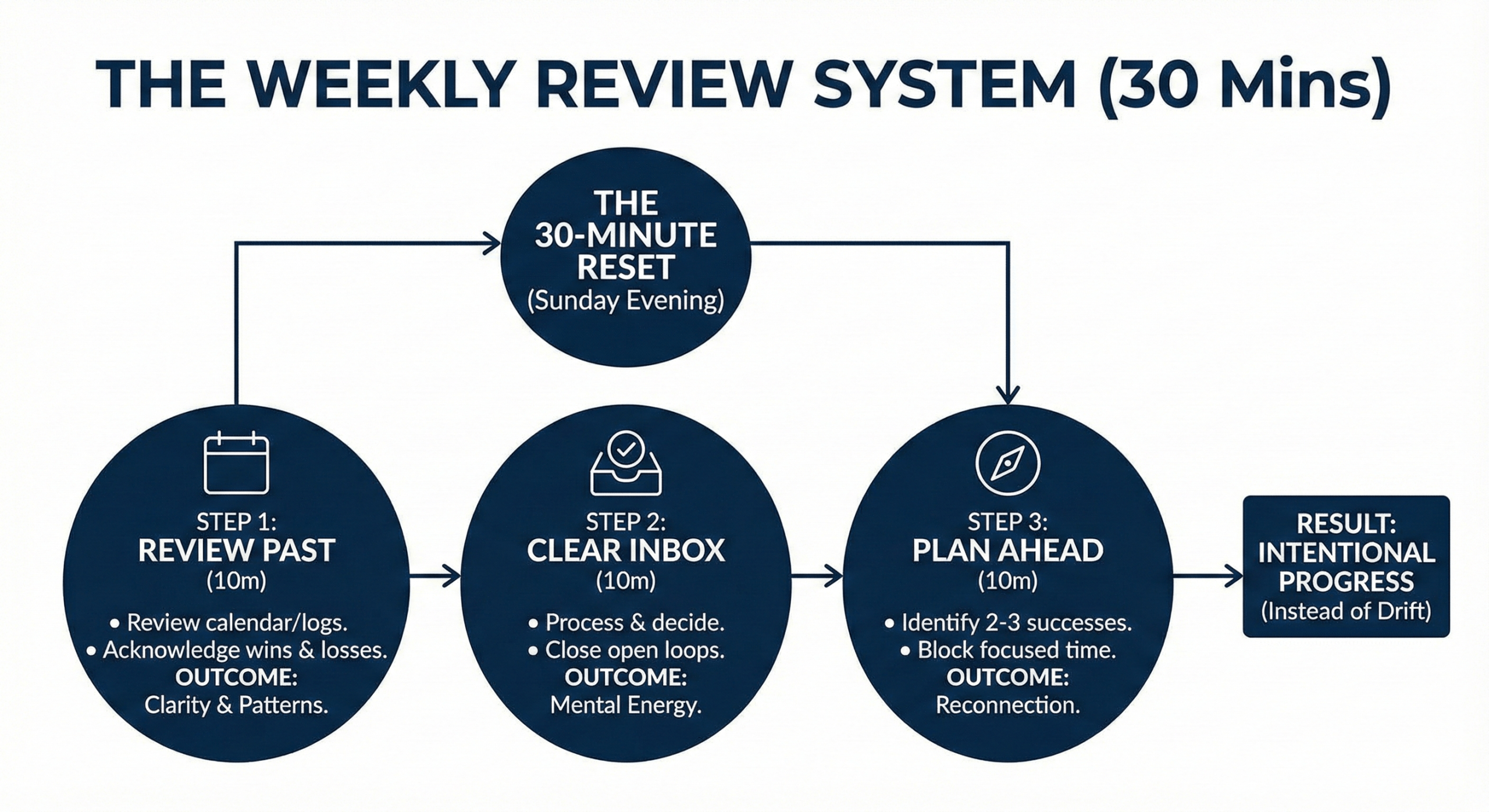
My Weekly Review Process
I do this every Sunday evening. It takes 30 minutes, sometimes less.
You can adjust the timing to what works for you—Friday afternoon, Sunday morning, Monday before work. The key is consistency, not perfection.
Step 1: Review the Past Week (10 minutes)
I open my calendar and look back at the week that just ended.
I ask myself:
- What did I accomplish that mattered?
- What took more time than it should have?
- What conversations or decisions were most important?
- What didn’t get done, and does it still matter?
I’m not writing essays. Just quick notes. Usually bullet points.
The goal is to acknowledge what happened—both good and bad—before moving forward.
Step 2: Clear Your Inbox and Tasks (10 minutes)
I go through my email inbox, message apps, and task list.
For each item, I decide:
- Does this need action? If yes, when?
- Can someone else handle this?
- Does this actually matter?
Most things get deleted, delegated, or scheduled. The rest goes on a “someday” list that I review monthly.
This step isn’t about doing everything. It’s about getting clarity on what needs attention and what doesn’t.
Step 3: Plan the Week Ahead (10 minutes)
I look at my calendar for the coming week and identify:
- What are the 2-3 outcomes that would make this week successful?
- What meetings or commitments do I have?
- Where are my blocks of focused time?
Notice I’m not planning every task or every hour. I’m just identifying the few things that matter most and making sure I have time protected for them.
That’s it. Three steps, 30 minutes, once a week.
What Changed for Me
Before I started weekly reviews, I was reactive. I’d wake up Monday and respond to whatever was in front of me. By Friday, I’d realize I spent the entire week on other people’s priorities.
Now, I spend Sunday evening getting clear on what actually matters. When Monday comes, I already know where my energy should go.
This simple shift changed everything:
I stopped feeling overwhelmed
When everything lives in your head, it all feels urgent. The review gets it out of your head and onto paper where you can see it clearly.
Most of what felt overwhelming turns out to be manageable once you write it down.
I got better at saying no
The review forced me to see where my time was actually going. I noticed how many meetings I was attending that didn’t matter. How many favors I was doing that weren’t reciprocated. How many “quick tasks” were adding up to hours.
Once I saw the patterns, saying no became easier.
I stopped drifting
Without regular check-ins, it’s easy to spend weeks on things that don’t align with your goals. You’re busy, but you’re not making progress.
The weekly review keeps me connected to what I said was important. When I notice drift, I can course-correct quickly instead of waking up months later and wondering what happened.
I learned from experience
The review creates a feedback loop. I notice what worked and what didn’t. Which approaches saved time. Which commitments drained energy. Which people helped and which created problems.
This awareness compounds. You get better at decisions because you’re actually learning from the ones you already made.
Common Mistakes
Making it too complicated
The weekly review isn’t a journaling session or deep soul-searching exercise. It’s a practical check-in. Keep it simple.
Skipping it when things are busy
That’s exactly when you need it most. If you can’t find 30 minutes to review your week, that’s a sign you’re not in control of your time.
Only focusing on what went wrong
The review isn’t about beating yourself up. Notice what worked, too. What gave you energy. What produced results. Do more of that.
Not acting on what you learn
The point isn’t just reflection. It’s using what you learn to make next week better. If you notice a pattern, change something.
Making It Work for You
You don’t need to copy my exact process. Adjust it to fit your life.
Some people prefer Friday afternoon so they can disconnect for the weekend. Others like Monday morning to start fresh. Some do 15 minutes, others do an hour.
The structure matters less than the consistency.
What matters is that you pause regularly to:
- Acknowledge what happened
- Clear your head
- Get clear on what’s next
That’s the core. Everything else is just details.
Start This Week
You don’t need a special system or app. Just set aside 30 minutes this Sunday.
Look back at your week. What mattered? What didn’t? What do you want next week to look like?
Write down a few notes. Clear your inbox. Identify 2-3 priorities for the coming week.
That’s it.
Do that for a month and see what changes. You’ll probably notice you feel more in control, less overwhelmed, and clearer about where your time should go.
The weekly review won’t solve every problem. But it will help you see your problems more clearly. And that’s usually the first step to solving them.
Leave a Reply